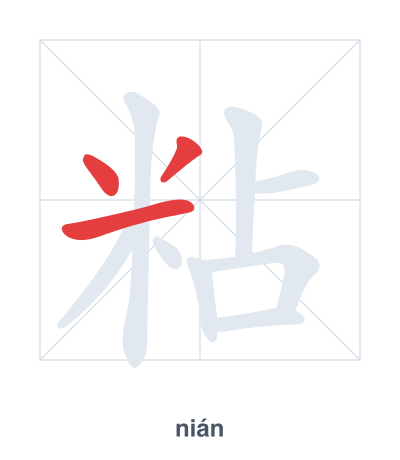
粘 (nián) means "to stick; sticky" in Chinese. It has 11 strokes with the radical 米. Difficulty: 4.2/5.
to stick; sticky
The character 粘 (nián) is written with 11 strokes. Follow the standard Chinese stroke order: top to bottom, left to right, outside before inside. The radical 米 is one of its key components.
Practice the correct stroke order with the Hanzi Writer app to see animated stroke-by-stroke guidance with real-time feedback.
粘 is pronounced nián in Mandarin Chinese. It means to stick; sticky.
This is a polyphonic character with readings: nián, zhān.
请将这张海报粘贴在教室后方的宣传栏上。
qǐng jiāng zhè zhāng hǎi bào zhān tiē zài jiào shì hòu fāng de xuān chuán lán shàng
Please paste this poster on the bulletin board at the back of the classroom.
伤口上的纱布有些粘连,撕开时要格外小心。
shāng kǒu shàng de shā bù yǒu xiē zhān lián sī kāi shí yào gé wài xiǎo xīn
The gauze on the wound is sticking a bit; be extra careful when removing it.
这种糯米粥煮得非常粘稠,口感软糯。
zhè zhǒng nuò mǐ zhōu zhǔ dé fēi cháng nián chóu kǒu gǎn ruǎn nuò
This glutinous rice porridge is cooked very thick and has a soft, sticky texture.
这种胶水的粘性很强,可以用来修补瓷器。
zhè zhǒng jiāo shuǐ de zhān xìng hěn qiáng kě yǐ yòng lái xiū bǔ cí qì
This glue is very sticky and can be used to repair porcelain.
Open Hanzi Writer to see the animated stroke order and practice writing 粘 with real-time feedback.