蛋 (dàn) means "egg" in Chinese. It has 11 strokes with the radical 虫, and is HSK Level 1.
Rated 3.7/5 in difficulty (challenging).
Harder than 97% of HSK Level 1 characters.
Appears in 3+ common words including 鸡蛋 (jī dàn), 蛋糕 (dàn gāo), 坏蛋 (huài dàn).
Due to its 11 strokes, Hanzi Writer's error detection shows 蛋 requires focused practice — most learners need 10+ attempts for consistent accuracy.
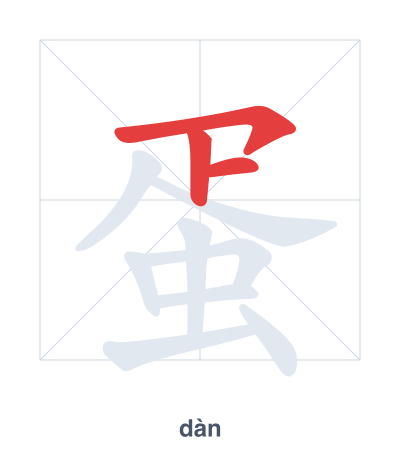
Open Hanzi Writer to see the animated stroke order and practice writing 蛋 with real-time feedback.
The character 蛋 (dàn) is written with 11 strokes. Follow the standard Chinese stroke order: top to bottom, left to right, outside before inside. The radical 虫 is one of its key components.
Practice the correct stroke order with the Hanzi Writer app to see animated stroke-by-stroke guidance with real-time feedback.
蛋 means egg.
As an HSK Level 1 character, 蛋 is among the first characters beginners learn.
The character 蛋 is a compound with the radical 虫 (chóng, insect/reptile) and the component 疋 (pǐ), which originally depicted a foot or step. This combination suggests the eggs laid by crawling creatures such as insects or reptiles.
💡 Memory Tip: Picture a cracked eggshell (疋) with an insect (虫) emerging from it—that's a 蛋 (egg).
我想吃鸡蛋。
wǒ xiǎng chī jī dàn
I want to eat eggs.
生日要吃蛋糕。
shēng rì yào chī dàn gāo
One should eat cake on their birthday.
他是个大坏蛋。
tā shì gè dà huài dàn
He is a big villain.
Open Hanzi Writer to see the animated stroke order and practice writing 蛋 with real-time feedback.
✨ Animated stroke order · Handwriting recognition · HSK-graded practice · Free to use
蛋 is a top-bottom character. The top part is 疋 (shū), which originally meant 'foot' but here acts as a phonetic component, and the bottom is 虫 (chóng, insect). Since insects lay eggs, the insect radical gives a clue that 蛋 refers to eggs, especially small ones.