粹 (cuì) means "Pure; essence." in Chinese. It has 14 strokes with the radical 米, and is HSK Level 7.
Rated 4.2/5 in difficulty (advanced).
Harder than 79% of HSK Level 7 characters.
Appears in 3+ common words including 纯粹 (chún cuì), 精粹 (jīng cuì), 国粹 (guó cuì).
Due to its 14 strokes, Hanzi Writer's error detection shows 粹 requires focused practice — most learners need 10+ attempts for consistent accuracy.
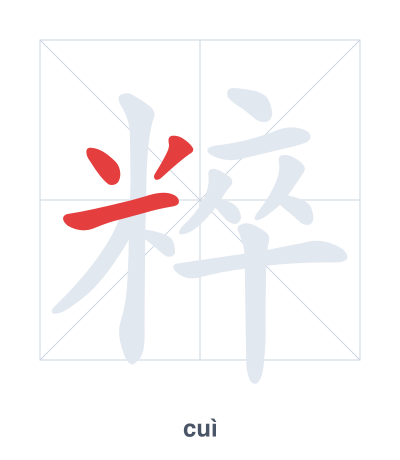
Open Hanzi Writer to see the animated stroke order and practice writing 粹 with real-time feedback.
The character 粹 (cuì) is written with 14 strokes. Follow the standard Chinese stroke order: top to bottom, left to right, outside before inside. The radical 米 is one of its key components.
Practice the correct stroke order with the Hanzi Writer app to see animated stroke-by-stroke guidance with real-time feedback.
粹 means Pure; essence..
As an HSK Level 7 character, 粹 is an intermediate-level character.
The character 粹 combines the radical 米 (rice) with 卒 (soldier/finish), suggesting rice that has been thoroughly processed to extract its pure essence. In ancient times, refining rice involved removing husks and impurities to obtain the finest grain, so 粹 came to mean 'pure' or 'essence'.
💡 Memory Tip: Picture a soldier (卒) meticulously picking out only the perfect, purest grains from a pile of rice (米) to make the finest meal.
他的汉语很纯粹。
tā de hàn yǔ hěn chún cuì
His Chinese is very pure.
这是文化的精粹。
zhè shì wén huà de jīng cuì
This is the essence of culture.
京剧是中国的国粹。
jīng jù shì zhōng guó de guó cuì
Peking Opera is a national treasure of China.
Open Hanzi Writer to see the animated stroke order and practice writing 粹 with real-time feedback.
✨ Animated stroke order · Handwriting recognition · HSK-graded practice · Free to use
The character 粹 is composed of the radical 米 (rice) on the left and 卒 (soldier or end) on the right. The 米 radical suggests refined grain, hinting at purity, while 卒 provides the pronunciation cuì. Together, they convey the idea of the pure, essential part of something, like polished rice.