醋 (cù) means "vinegar" in Chinese. It has 15 strokes with the radical 酉, and is HSK Level 6.
Rated 4.2/5 in difficulty (advanced).
Harder than 96% of HSK Level 6 characters.
Appears in 3+ common words including 吃醋 (chī cù), 陈醋 (chén cù), 醋意 (cù yì).
Due to its 15 strokes, Hanzi Writer's error detection shows 醋 requires focused practice — most learners need 10+ attempts for consistent accuracy.
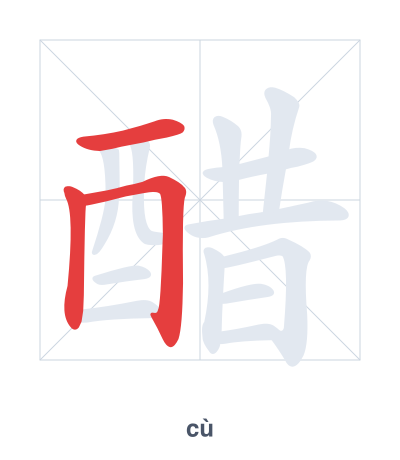
Open Hanzi Writer to see the animated stroke order and practice writing 醋 with real-time feedback.
The character 醋 (cù) is written with 15 strokes. Follow the standard Chinese stroke order: top to bottom, left to right, outside before inside. The radical 酉 is one of its key components.
Practice the correct stroke order with the Hanzi Writer app to see animated stroke-by-stroke guidance with real-time feedback.
醋 means vinegar.
As an HSK Level 6 character, 醋 is an intermediate-level character.
醋 combines 酉 (wine jar) with 昔 (ancient/past), suggesting 'aged wine' or 'fermented wine' that turns sour into vinegar. The 酉 radical links to fermentation and liquids, while 昔 indicates the passing of time needed for the sour transformation.
💡 Memory Tip: Imagine an old (昔) wine jar (酉) left too long, and when you taste it—yuck, it's sour vinegar!
他很容易吃醋。
tā hěn róng yì chī cù
He gets jealous easily.
山西陈醋很有名。
shān xī chén cù hěn yǒu míng
Shanxi aged vinegar is very famous.
她的话里带着醋意。
tā de huà lǐ dài zhe cù yì
Her words were tinged with jealousy.
Open Hanzi Writer to see the animated stroke order and practice writing 醋 with real-time feedback.
✨ Animated stroke order · Handwriting recognition · HSK-graded practice · Free to use
醋 combines the radical 酉 (meaning wine or fermentation) on the left with the phonetic component 昔 (xī) on the right. The radical 酉 suggests the character relates to fermented liquids like vinegar, while 昔 provides the pronunciation cue. So the overall structure indicates a type of fermented liquid that is sour.