吃 (chī) means "to eat" in Chinese. It has 6 strokes with the radical 口, and is HSK Level 1.
Rated 2.7/5 in difficulty (moderate).
Harder than 39% of HSK Level 1 characters.
Appears in 3+ common words including 吃饭 (chī fàn), 好吃 (hǎo chī), 小吃 (xiǎo chī).
Hanzi Writer's stroke validation shows learners typically need 5-8 attempts to write 吃 with correct proportion and order.
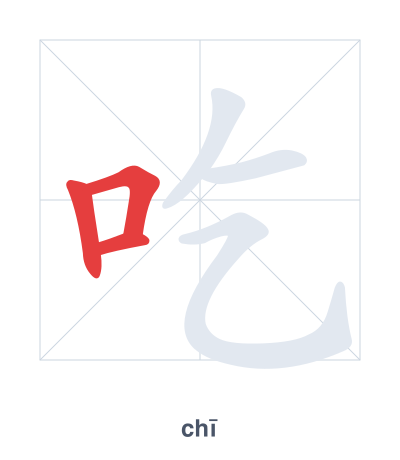
Open Hanzi Writer to see the animated stroke order and practice writing 吃 with real-time feedback.
The character 吃 (chī) is written with 6 strokes. Follow the standard Chinese stroke order: top to bottom, left to right, outside before inside. The radical 口 is one of its key components.
Practice the correct stroke order with the Hanzi Writer app to see animated stroke-by-stroke guidance with real-time feedback.
吃 means to eat.
As an HSK Level 1 character, 吃 is among the first characters beginners learn.
This character combines the mouth radical 口 with 乞 (beg), originally depicting a person kneeling and begging with an open mouth. Over time, its meaning shifted from 'stammer' to 'eat,' as the mouth is central to this basic human activity.
💡 Memory Tip: Picture a person (乞) bending down to shove food into their wide-open mouth (口).
我们一起去吃饭吧。
wǒ men yì qǐ qù chī fàn ba
Let's go eat together.
这个菜真的很好吃。
zhè ge cài zhēn de hěn hǎo chī
This dish is really delicious.
这里有很多特色小吃。
zhè lǐ yǒu hěn duō tè sè xiǎo chī
There are many local snacks here.
Open Hanzi Writer to see the animated stroke order and practice writing 吃 with real-time feedback.
✨ Animated stroke order · Handwriting recognition · HSK-graded practice · Free to use
The character 吃 is made of two parts: the left radical 口 (mouth) and the right part 乞. The mouth radical shows that the meaning is related to the mouth, as eating is done with the mouth. The right part 乞 originally meant "to beg" and here suggests the action of taking food into the mouth.