踹 (chuài) means "to kick; to tread on" in Chinese. It has 16 strokes with the radical 足, and is HSK Level 7.
Rated 4.2/5 in difficulty (advanced).
Harder than 91% of HSK Level 7 characters.
Appears in 3+ common words including 踹门 (chuài mén), 踹了一脚 (chuài le yī jiǎo), 踹开 (chuài kāi).
Due to its 16 strokes, Hanzi Writer's error detection shows 踹 requires focused practice — most learners need 10+ attempts for consistent accuracy.
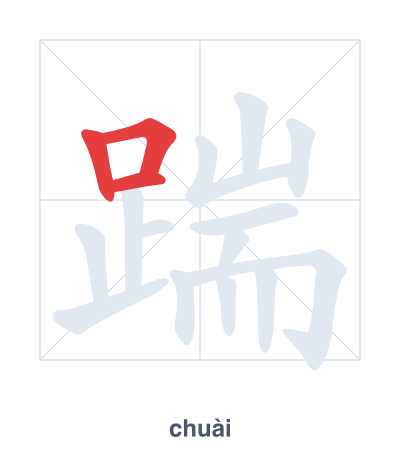
Open Hanzi Writer to see the animated stroke order and practice writing 踹 with real-time feedback.
The character 踹 (chuài) is written with 16 strokes. Follow the standard Chinese stroke order: top to bottom, left to right, outside before inside. The radical 足 is one of its key components.
Practice the correct stroke order with the Hanzi Writer app to see animated stroke-by-stroke guidance with real-time feedback.
踹 means to kick; to tread on.
As an HSK Level 7 character, 踹 is an intermediate-level character.
踹 is a compound character with the radical 足 (foot) and the phonetic component 耑 (duān, meaning 'tip' or 'point'). The foot radical indicates the action is done with the foot, while the phonetic gives a hint to the sound; together, they depict a forceful kicking motion, as if the foot strikes a precise point.
💡 Memory Tip: Picture your foot (足) kicking a sharp tip (耑) so hard it flies off with a loud 'chuài!'
他用力踹门。
tā yòng lì chuài mén
He kicked the door hard.
他由于太生气了,对着那个木桶狠狠地踹了一脚。
tā yóu yú tài shēng qì le , duì zhe nà ge mù tǒng hěn hěn dì chuài le yī jiǎo 。
Because he was so angry, he kicked the wooden bucket hard.
他把门踹开了。
tā bǎ mén chuài kāi le
He kicked the door open.
Open Hanzi Writer to see the animated stroke order and practice writing 踹 with real-time feedback.
✨ Animated stroke order · Handwriting recognition · HSK-graded practice · Free to use
The character 踹 is made of the radical 足 (foot) on the left and 耑 (duān, meaning tip or start) on the right. The foot radical directly connects to the action of kicking or treading, while 耑 adds a sense of force or pressure. Together, they form the idea of using the foot to push or strike something.