踅 (xué) means "to pace back and forth; to turn back" in Chinese. It has 14 strokes with the radical 足.
Rated 4.2/5 in difficulty (advanced).
Appears in 3+ common words including 踅摸 (xué mō), 踅了一圈 (xué le yī quān), 往回踅 (wǎng huí xué).
Due to its 14 strokes, Hanzi Writer's error detection shows 踅 requires focused practice — most learners need 10+ attempts for consistent accuracy.
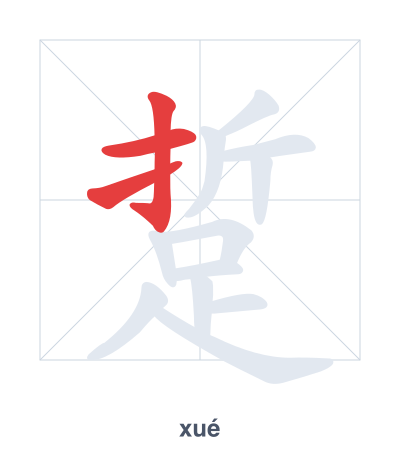
Open Hanzi Writer to see the animated stroke order and practice writing 踅 with real-time feedback.
The character 踅 (xué) is written with 14 strokes. Follow the standard Chinese stroke order: top to bottom, left to right, outside before inside. The radical 足 is one of its key components.
Practice the correct stroke order with the Hanzi Writer app to see animated stroke-by-stroke guidance with real-time feedback.
踅 means to pace back and forth; to turn back.
踅 is a compound character combining the radical 足 (foot) with 折 (to break/bend). The foot radical indicates walking movement, while 折 suggests turning or changing direction, together conveying the idea of pacing back and forth—a foot that keeps bending back in its path.
💡 Memory Tip: Imagine a foot (足) that keeps breaking (折) its stride by turning around, like someone nervously pacing in a hallway.
他在店里四处踅摸。
tā zài diàn lǐ sì chù xué mō
He is looking around for something in the shop.
他在门口踅了一圈。
tā zài mén kǒu xué le yī quān
He paced around the door.
他转身往回踅。
tā zhuǎn shēn wǎng huí xué
He turned around and walked back.
Open Hanzi Writer to see the animated stroke order and practice writing 踅 with real-time feedback.
✨ Animated stroke order · Handwriting recognition · HSK-graded practice · Free to use
踅 is composed of the radical 足 (foot) on the left, and the phonetic component 折 (zhé, to break/turn) on the right. The foot radical relates to walking, and 折 suggests a turning or bending motion, together indicating pacing back and forth or turning around.