足 (zú) means "foot; sufficient; enough" in Chinese. It has 7 strokes with the radical 足, and is HSK Level 3.
Rated 3.2/5 in difficulty (challenging).
Harder than 33% of HSK Level 3 characters.
Appears in 3+ common words including 足球 (zú qiú), 足够 (zú gòu), 满足 (mǎn zú).
Due to its 7 strokes, Hanzi Writer's error detection shows 足 requires focused practice — most learners need 10+ attempts for consistent accuracy.
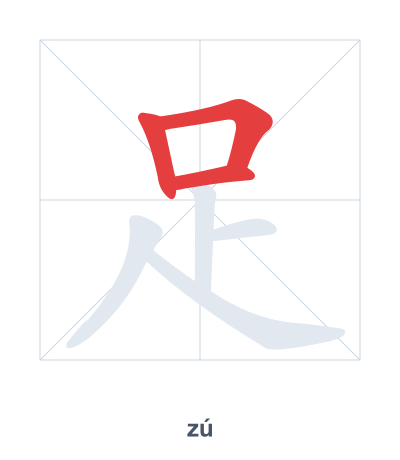
Open Hanzi Writer to see the animated stroke order and practice writing 足 with real-time feedback.
The character 足 (zú) is written with 7 strokes. Follow the standard Chinese stroke order: top to bottom, left to right, outside before inside. The radical 足 is one of its key components.
Practice the correct stroke order with the Hanzi Writer app to see animated stroke-by-stroke guidance with real-time feedback.
足 means foot; sufficient; enough.
As an HSK Level 3 character, 足 is an intermediate-level character.
足 is a pictograph of a human foot, originally depicting a thigh (top), lower leg, and toes in ancient oracle bone script. Over time, it simplified to the modern shape, still suggesting a foot and leg. The meaning 'sufficient' derives from the idea of having enough to stand on.
💡 Memory Tip: Picture a foot with a big toe pointing up and a heel curving down, like you're saying 'This foot is enough to stand on!'
我喜欢踢足球。
wǒ xǐ huān tī zú qiú
I like playing soccer.
这些钱足够了。
zhè xiē qián zú gòu le
This money is enough.
我感到很满足。
wǒ gǎn dào hěn mǎn zú
I feel very satisfied.
Open Hanzi Writer to see the animated stroke order and practice writing 足 with real-time feedback.
✨ Animated stroke order · Handwriting recognition · HSK-graded practice · Free to use
足 is a pictographic character that originally depicted a human leg and foot. The top part represents the knee or thigh, and the bottom part represents the foot, so the whole character directly means "foot." Over time, it also gained the extended meanings of "sufficient" and "enough" through semantic shift in Chinese usage.