呵 (hē) means "to breathe out / to scold / oh" in Chinese. It has 8 strokes with the radical 口, and is HSK Level 7.
Rated 3.7/5 in difficulty (challenging).
Harder than 23% of HSK Level 7 characters.
Appears in 3+ common words including 呵呵 (hē hē), 呵 (hē), 呵气 (hē qì).
Due to its 8 strokes, Hanzi Writer's error detection shows 呵 requires focused practice — most learners need 10+ attempts for consistent accuracy.
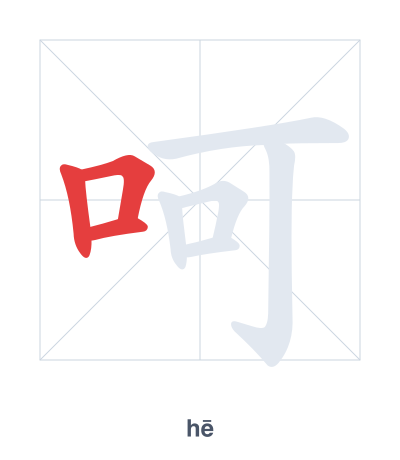
Open Hanzi Writer to see the animated stroke order and practice writing 呵 with real-time feedback.
The character 呵 (hē) is written with 8 strokes. Follow the standard Chinese stroke order: top to bottom, left to right, outside before inside. The radical 口 is one of its key components.
Practice the correct stroke order with the Hanzi Writer app to see animated stroke-by-stroke guidance with real-time feedback.
呵 means to breathe out / to scold / oh.
As an HSK Level 7 character, 呵 is an intermediate-level character.
呵 combines the mouth radical (口) with 可, which originally depicted an open mouth exhaling air. This created the meanings of breathing out, scolding (forceful exhalation), and the interjection 'oh'.
💡 Memory Tip: Picture a mouth (口) that can (可) huff out a sharp 'heh!' to scold someone.
他呵呵地笑了。
tā hē hē dì xiào le
He chuckled.
呵,真不简单!
hē zhēn bù jiǎn dān
Oh, it's really not simple!
他向手心呵气。
tā xiàng shǒu xīn hē qì
He breathed on his palms.
Open Hanzi Writer to see the animated stroke order and practice writing 呵 with real-time feedback.
✨ Animated stroke order · Handwriting recognition · HSK-graded practice · Free to use
呵 is a phono-semantic compound. The left radical 口 (mouth) indicates actions or sounds related to the mouth, like breathing or speaking. The right part 可 (kě) gives the sound of the character and also suggests the idea of "can" or "allow," linking to the meaning of scolding or exclaiming.