逸 (yì) means "leisurely; to escape" in Chinese. It has 11 strokes with the radical 辶, and is HSK Level 7.
Rated 4.2/5 in difficulty (advanced).
Harder than 93% of HSK Level 7 characters.
Appears in 3+ common words including 安逸 (ān yì), 逃逸 (táo yì), 飘逸 (piāo yì).
Due to its 11 strokes, Hanzi Writer's error detection shows 逸 requires focused practice — most learners need 10+ attempts for consistent accuracy.
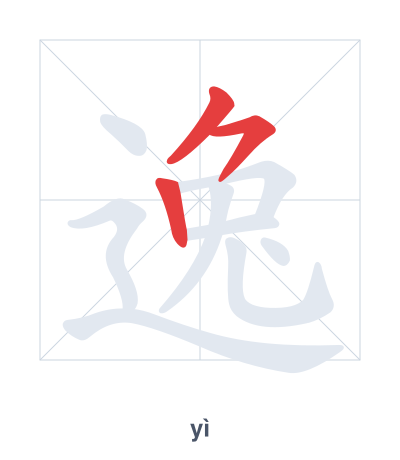
Open Hanzi Writer to see the animated stroke order and practice writing 逸 with real-time feedback.
The character 逸 (yì) is written with 11 strokes. Follow the standard Chinese stroke order: top to bottom, left to right, outside before inside. The radical 辶 is one of its key components.
Practice the correct stroke order with the Hanzi Writer app to see animated stroke-by-stroke guidance with real-time feedback.
逸 means leisurely; to escape.
As an HSK Level 7 character, 逸 is an intermediate-level character.
逸 combines the radical 辶 (walk/run) with 兔 (rabbit), suggesting a rabbit darting away—hence the meanings 'to escape' and 'leisurely' (freedom from haste).
💡 Memory Tip: Picture a rabbit (兔) speeding off on a path (辶) to a life of leisurely escape.
他过着安逸的生活。
tā guò zhe ān yì de shēng huó
He lives a life of ease and comfort.
那辆车肇事逃逸了。
nà liàng chē zhào shì táo yì le
That car was involved in a hit-and-run.
她的长发很飘逸。
tā de cháng fà hěn piāo yì
Her long hair is flowing and elegant.
Open Hanzi Writer to see the animated stroke order and practice writing 逸 with real-time feedback.
✨ Animated stroke order · Handwriting recognition · HSK-graded practice · Free to use
逸 consists of the walk radical 辶 (chuò) on the left and 免 (miǎn, 'to avoid') on the right. The walk radical suggests movement, and 免 adds the idea of avoiding something, together forming the meanings 'to escape' or 'leisurely' (as in escaping from work or hassle).