趴 (pā) means "to lie on one's stomach; to lean over" in Chinese. It has 9 strokes with the radical 足, and is HSK Level 7.
Rated 4/5 in difficulty (challenging).
Harder than 46% of HSK Level 7 characters.
Appears in 3+ common words including 趴下 (pā xià), 趴着 (pā zhe), 趴在桌上 (pā zài zhuō shàng).
Due to its 9 strokes, Hanzi Writer's error detection shows 趴 requires focused practice — most learners need 10+ attempts for consistent accuracy.
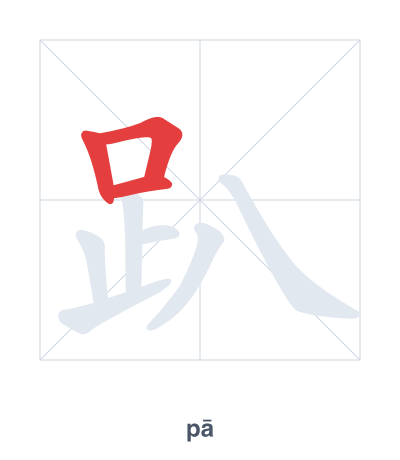
Open Hanzi Writer to see the animated stroke order and practice writing 趴 with real-time feedback.
The character 趴 (pā) is written with 9 strokes. Follow the standard Chinese stroke order: top to bottom, left to right, outside before inside. The radical 足 is one of its key components.
Practice the correct stroke order with the Hanzi Writer app to see animated stroke-by-stroke guidance with real-time feedback.
趴 means to lie on one's stomach; to lean over.
As an HSK Level 7 character, 趴 is an intermediate-level character.
The character 趴 combines the radical 足 (foot) with the component 八 (eight), which visually suggests legs spread apart like the number eight. This depicts the posture of lying on one's stomach with splayed legs, emphasizing the foot position when prone.
💡 Memory Tip: Imagine a person lying on their stomach, their two feet forming the shape of the number eight (八) as they sprawl on the ground.
快点趴下!
kuài diǎn pā xià
Get down quickly!
他趴着睡觉。
tā pā zhe shuì jiào
He sleeps on his stomach.
别趴在桌上写字。
bié pā zài zhuō shàng xiě zì
Don't slouch over the table to write.
Open Hanzi Writer to see the animated stroke order and practice writing 趴 with real-time feedback.
✨ Animated stroke order · Handwriting recognition · HSK-graded practice · Free to use
趴 has the radical 足 (zú, foot) on the left side and the phonetic component 八 (bā, eight) on the right. The radical 足 suggests an action related to feet or legs, which fits the meaning of lying on one's stomach or leaning forward. The right part 八 gives a hint to the pronunciation "pā" but does not directly contribute to the meaning.