柄 (bǐng) means "Handle, stalk, or stem." in Chinese. It has 9 strokes with the radical 木, and is HSK Level 7.
Rated 4/5 in difficulty (challenging).
Harder than 41% of HSK Level 7 characters.
Appears in 3+ common words including 把柄 (bǎ bǐng), 伞柄 (sǎn bǐng), 叶柄 (yè bǐng).
Due to its 9 strokes, Hanzi Writer's error detection shows 柄 requires focused practice — most learners need 10+ attempts for consistent accuracy.
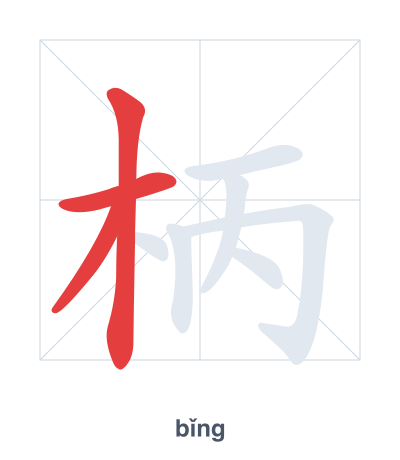
Open Hanzi Writer to see the animated stroke order and practice writing 柄 with real-time feedback.
The character 柄 (bǐng) is written with 9 strokes. Follow the standard Chinese stroke order: top to bottom, left to right, outside before inside. The radical 木 is one of its key components.
Practice the correct stroke order with the Hanzi Writer app to see animated stroke-by-stroke guidance with real-time feedback.
柄 means Handle, stalk, or stem..
As an HSK Level 7 character, 柄 is an intermediate-level character.
柄 combines the wood radical 木 (tree/wood) with 丙, which originally was a pictograph of a handle or a stand, to mean a wooden handle or plant stalk.
💡 Memory Tip: Imagine a tree (木) with a third branch shaped like a handle (丙 resembles the Chinese numeral 3) that you can grab.
他抓住了对方的把柄。
tā zhuā zhù le duì fāng de bǎ bǐng
He found leverage against the other party.
伞柄断了。
sǎn bǐng duàn le
The umbrella handle is broken.
叶柄连接着叶子。
yè bǐng lián jiē zhe yè zi
The petiole connects to the leaf.
Open Hanzi Writer to see the animated stroke order and practice writing 柄 with real-time feedback.
✨ Animated stroke order · Handwriting recognition · HSK-graded practice · Free to use
柄 is composed of the radical 木 (wood) on the left, suggesting that handles are often made of wood, and the phonetic component 丙 (bǐng) on the right, which gives the sound. Together, they create a character meaning 'handle', 'stalk', or 'stem' — something you grip or that attaches a leaf to a branch.