趸 (dǔn) means "wholesale; bulk; to store up" in Chinese. It has 10 strokes with the radical 足.
Rated 4.2/5 in difficulty (advanced).
Appears in 3+ common words including 趸卖 (dǔn mài), 趸船 (dǔn chuán), 趸批 (dǔn pī).
Due to its 10 strokes, Hanzi Writer's error detection shows 趸 requires focused practice — most learners need 10+ attempts for consistent accuracy.
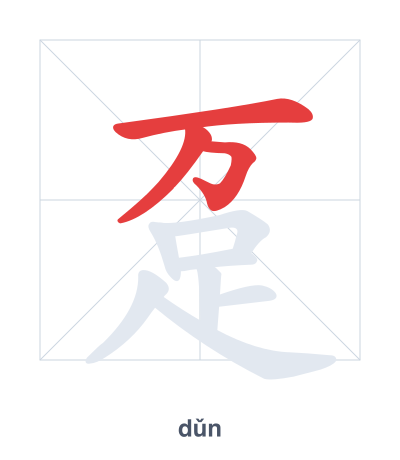
Open Hanzi Writer to see the animated stroke order and practice writing 趸 with real-time feedback.
The character 趸 (dǔn) is written with 10 strokes. Follow the standard Chinese stroke order: top to bottom, left to right, outside before inside. The radical 足 is one of its key components.
Practice the correct stroke order with the Hanzi Writer app to see animated stroke-by-stroke guidance with real-time feedback.
趸 means wholesale; bulk; to store up.
趸 is a compound character: the radical 足 (foot) hints at a place where goods are gathered or stored, while the phonetic component 万 (wàn, meaning 'ten thousand') suggests a large quantity. Together they depict the idea of buying or storing goods in bulk, as in wholesale transactions.
💡 Memory Tip: Imagine a giant foot (足) stomping down on ten thousand (万) boxes, crushing them into one big wholesale pile.
商店在趸卖旧货。
shāng diàn zài dǔn mài jiù huò
The store is selling old goods in bulk.
码头边有一只趸船。
mǎ tóu biān yǒu yī zhī dǔn chuán
There is a pontoon by the pier.
他想趸批一些水果。
tā xiǎng dǔn pī yī xiē shuǐ guǒ
He wants to buy some fruit in bulk.
Open Hanzi Writer to see the animated stroke order and practice writing 趸 with real-time feedback.
✨ Animated stroke order · Handwriting recognition · HSK-graded practice · Free to use
趸 combines the radical 足 (foot) on top with 万 (ten thousand) below, though 万 here provides a phonetic clue rather than a literal meaning. The radical 足 suggests that wholesale or bulk activities often involve traveling or transporting goods by foot or vehicle. Together, the character conveys the idea of a large quantity (like ten thousand) being moved or stored.