抚 (fǔ) means "to comfort; to stroke; to foster" in Chinese. It has 7 strokes with the radical 扌, and is HSK Level 7.
Rated 3.5/5 in difficulty (challenging).
Harder than 18% of HSK Level 7 characters.
Appears in 3+ common words including 抚摸 (fǔ mō), 安抚 (ān fǔ), 抚养 (fǔ yǎng).
Due to its 7 strokes, Hanzi Writer's error detection shows 抚 requires focused practice — most learners need 10+ attempts for consistent accuracy.
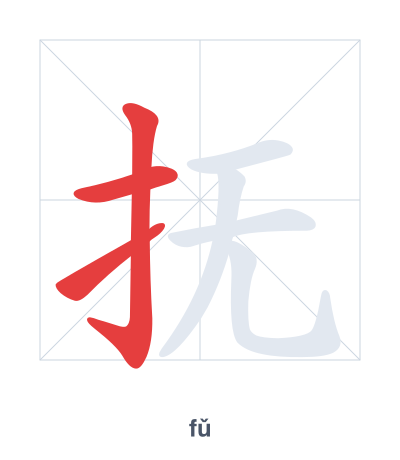
Open Hanzi Writer to see the animated stroke order and practice writing 抚 with real-time feedback.
The character 抚 (fǔ) is written with 7 strokes. Follow the standard Chinese stroke order: top to bottom, left to right, outside before inside. The radical 扌 is one of its key components.
Practice the correct stroke order with the Hanzi Writer app to see animated stroke-by-stroke guidance with real-time feedback.
抚 means to comfort; to stroke; to foster.
As an HSK Level 7 character, 抚 is an intermediate-level character.
抚 combines the hand radical 扌 with the phonetic component 无 (wú, meaning 'not have'). The hand suggests the action of stroking or comforting, as in patting someone gently to soothe their troubles away.
💡 Memory Tip: Imagine a hand (扌) reaching out to comfort a person who has no (无) fears left.
她轻轻抚摸小猫。
tā qīng qīng fǔ mō xiǎo māo
She gently stroked the kitten.
老师在安抚哭泣的孩子。
lǎo shī zài ān fǔ kū qì de hái zi
The teacher is comforting the crying child.
他独自抚养两个孩子。
tā dú zì fǔ yǎng liǎng gè hái zi
He raised two children on his own.
Open Hanzi Writer to see the animated stroke order and practice writing 抚 with real-time feedback.
✨ Animated stroke order · Handwriting recognition · HSK-graded practice · Free to use
抚 is made of the radical 扌 (hand) on the left and 无 (wú, without) on the right. The hand radical suggests actions done with the hand, like stroking or comforting. The right side 无 hints at removing worry or trouble, so together the character means to comfort or soothe someone.