开 (kāi) means "to open; to start; to drive" in Chinese. It has 4 strokes with the radical 廾, and is HSK Level 1.
Rated 2.2/5 in difficulty (moderate).
Harder than 25% of HSK Level 1 characters.
Appears in 3+ common words including 开始 (kāi shǐ), 开车 (kāi chē), 开心 (kāi xīn).
Hanzi Writer's stroke validation shows learners typically need 5-8 attempts to write 开 with correct proportion and order.
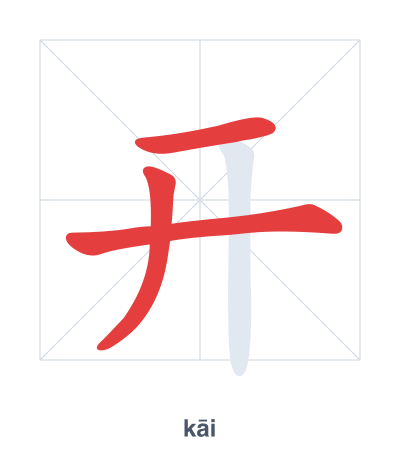
Open Hanzi Writer to see the animated stroke order and practice writing 开 with real-time feedback.
The character 开 (kāi) is written with 4 strokes. Follow the standard Chinese stroke order: top to bottom, left to right, outside before inside. The radical 廾 is one of its key components.
Practice the correct stroke order with the Hanzi Writer app to see animated stroke-by-stroke guidance with real-time feedback.
开 means to open; to start; to drive.
As an HSK Level 1 character, 开 is among the first characters beginners learn.
The character 开 combines a horizontal bar (一) with two hands (廾), depicting hands pushing up a bar to open a door or gate. Its ancient form showed hands removing a crossbar, directly symbolizing the action of opening.
💡 Memory Tip: Picture two hands (廾) lifting a horizontal bar (一) to swing open a heavy gate.
电影快要开始了。
diàn yǐng kuài yào kāi shǐ le
The movie is about to start.
你会开车吗?
nǐ huì kāi chē ma
Can you drive?
今天我很开心。
jīn tiān wǒ hěn kāi xīn
I am very happy today.
Open Hanzi Writer to see the animated stroke order and practice writing 开 with real-time feedback.
✨ Animated stroke order · Handwriting recognition · HSK-graded practice · Free to use
开 is made of a top horizontal stroke representing a bar and a bottom part that looks like two hands (radical 廾). Together, they show two hands lifting a bar to open a door or gate. This structure directly gives the idea of opening something.