跂 (qí) means "to stand on tiptoe" in Chinese. It has 11 strokes with the radical 足.
Rated 4.2/5 in difficulty (advanced).
Appears in 3+ common words including 跂望 (qí wàng), 跂立 (qí lì), 跂足 (qí zú).
Due to its 11 strokes, Hanzi Writer's error detection shows 跂 requires focused practice — most learners need 10+ attempts for consistent accuracy.
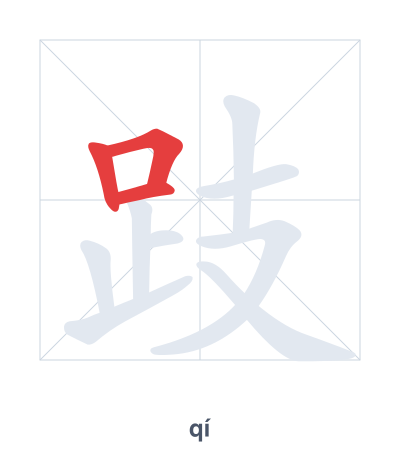
Open Hanzi Writer to see the animated stroke order and practice writing 跂 with real-time feedback.
The character 跂 (qí) is written with 11 strokes. Follow the standard Chinese stroke order: top to bottom, left to right, outside before inside. The radical 足 is one of its key components.
Practice the correct stroke order with the Hanzi Writer app to see animated stroke-by-stroke guidance with real-time feedback.
跂 means to stand on tiptoe.
This compound character combines the radical 足 (foot) with 支 (branch or prop). The idea is of using the foot to prop oneself up onto something, like a branch, hence standing on tiptoe to reach higher.
💡 Memory Tip: Picture a person standing on tiptoe on a branch (支), balancing with their foot (足) to peek over a wall.
他跂望远方的亲人。
tā qí wàng yuǎn fāng de qīn rén
He is looking into the distance, longing for his relatives.
仙鹤在水中跂立。
xiān hè zài shuǐ zhōng qí lì
The crane stood on its tiptoes in the water.
他跂足而待好消息。
tā qí zú ér dài hǎo xiāo xī
He is waiting on tiptoe for the good news.
Open Hanzi Writer to see the animated stroke order and practice writing 跂 with real-time feedback.
✨ Animated stroke order · Handwriting recognition · HSK-graded practice · Free to use
跂 is made of two parts: the left radical 足 (foot) and the right part 支 (branch or support). The foot radical shows it is a foot action, and 支 suggests stretching or supporting, like standing on tiptoe to reach something.