趵 (bào) means "to leap; to jump" in Chinese. It has 10 strokes with the radical 足.
Rated 4.2/5 in difficulty (advanced).
Appears in 3+ common words including 趵突泉 (bào tū quán), 趵突 (bào tū), 趵趵 (bào bào).
Due to its 10 strokes, Hanzi Writer's error detection shows 趵 requires focused practice — most learners need 10+ attempts for consistent accuracy.
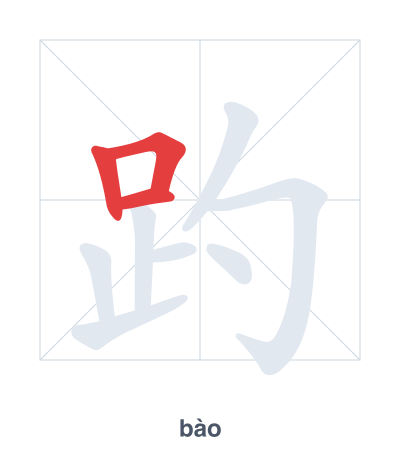
Open Hanzi Writer to see the animated stroke order and practice writing 趵 with real-time feedback.
The character 趵 (bào) is written with 10 strokes. Follow the standard Chinese stroke order: top to bottom, left to right, outside before inside. The radical 足 is one of its key components.
Practice the correct stroke order with the Hanzi Writer app to see animated stroke-by-stroke guidance with real-time feedback.
趵 means to leap; to jump.
趵 is a compound character with the radical 足 (foot) indicating movement, and the component 勺 (spoon) serving as a phonetic hint for the pronunciation bào. The foot radical directly ties to the meaning of leaping or jumping, as the action involves the feet.
💡 Memory Tip: Imagine a foot (足) kicking a spoon (勺) so hard that it leaps into the air.
趵突泉在济南。
bào tū quán zài jǐ nán
Baotu Spring is in Jinan.
泉水趵突而出。
quán shuǐ bào tū ér chū
The spring water gushes out with a leap.
听到趵趵的蹄声。
tīng dào bào bào de tí shēng
Heard the clip-clop of hooves.
Open Hanzi Writer to see the animated stroke order and practice writing 趵 with real-time feedback.
✨ Animated stroke order · Handwriting recognition · HSK-graded practice · Free to use
趵 is composed of two parts: the radical 足 (zú, meaning "foot") on the left, and the phonetic component 勺 (bào, though now pronounced sháo) on the right. Since leaping or jumping involves the feet, the radical 足 directly hints at the action. The right side provides a clue to the pronunciation.