跽 (jì) means "to kneel (with the upper body straight)" in Chinese. It has 14 strokes with the radical 足.
Rated 4.2/5 in difficulty (advanced).
Appears in 3+ common words including 跽坐 (jì zuò), 跽跪 (jì guì), 跽受 (jì shòu).
Due to its 14 strokes, Hanzi Writer's error detection shows 跽 requires focused practice — most learners need 10+ attempts for consistent accuracy.
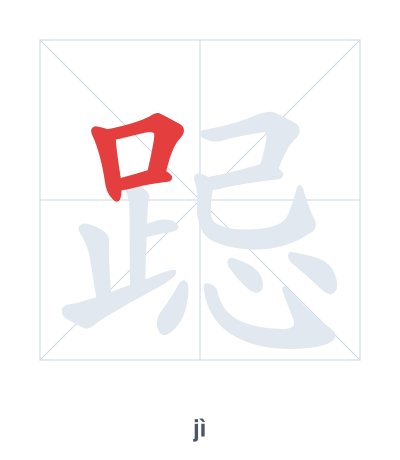
Open Hanzi Writer to see the animated stroke order and practice writing 跽 with real-time feedback.
The character 跽 (jì) is written with 14 strokes. Follow the standard Chinese stroke order: top to bottom, left to right, outside before inside. The radical 足 is one of its key components.
Practice the correct stroke order with the Hanzi Writer app to see animated stroke-by-stroke guidance with real-time feedback.
跽 means to kneel (with the upper body straight).
跽 combines the radical 足 (foot, indicating kneeling with the legs) with 忌 (jì, 'to fear/avoid'), which provides pronunciation and hints at the reverent or cautious attitude of kneeling with a straight back in ancient rituals.
💡 Memory Tip: Picture a respectful person kneeling on their heels (足) while thinking, 'I must avoid (忌) any disrespect by keeping my back straight.'
古人习惯跽坐。
gǔ rén xí guàn jì zuò
Ancient people were accustomed to sitting on their heels.
他跽跪在垫子上。
tā jì guì zài diàn zi shàng
He knelt on the mat.
他跽受长辈的教诲。
tā jì shòu zhǎng bèi de jiào huì
He knelt to receive the teachings of his elders.
Open Hanzi Writer to see the animated stroke order and practice writing 跽 with real-time feedback.
✨ Animated stroke order · Handwriting recognition · HSK-graded practice · Free to use
The character 跽 is composed of the radical 足 (foot) on the left, and the phonetic component 忌 (jì) on the right. The radical shows that the character involves the foot or a leg action, while the phonetic hints at pronunciation. Together, they form the meaning of kneeling with the upper body straight, a specific posture.