哀 (āi) means "sorrow" in Chinese. It has 9 strokes with the radical 口, and is HSK Level 7.
Rated 4/5 in difficulty (challenging).
Harder than 38% of HSK Level 7 characters.
Appears in 3+ common words including 悲哀 (bēi āi), 哀求 (āi qiú), 哀悼 (āi dào).
Due to its 9 strokes, Hanzi Writer's error detection shows 哀 requires focused practice — most learners need 10+ attempts for consistent accuracy.
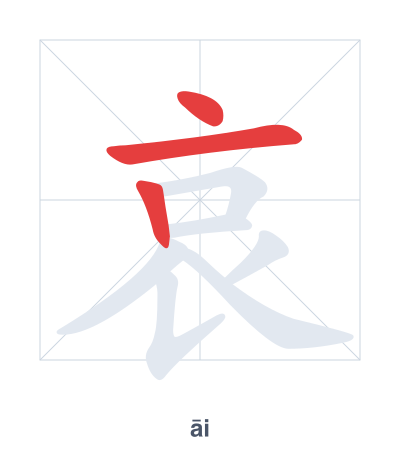
Open Hanzi Writer to see the animated stroke order and practice writing 哀 with real-time feedback.
The character 哀 (āi) is written with 9 strokes. Follow the standard Chinese stroke order: top to bottom, left to right, outside before inside. The radical 口 is one of its key components.
Practice the correct stroke order with the Hanzi Writer app to see animated stroke-by-stroke guidance with real-time feedback.
哀 means sorrow.
As an HSK Level 7 character, 哀 is an intermediate-level character.
哀 combines 口 (mouth) and 衣 (clothing). The ancient form showed a mouth inside clothing, symbolizing a person covering their mouth to muffle cries of sorrow.
💡 Memory Tip: Imagine a person wrapped in a cloak (衣) with a mouth (口) open, letting out a sorrowful 'Ai!'
这是一个悲哀的故事。
zhè shì yí gè bēi āi de gù shì
This is a sad story.
他哀求老师帮帮他。
tā āi qiú lǎo shī bāng bāng tā
He begged the teacher to help him.
我们在哀悼死者。
wǒ men zài āi dào sǐ zhě
We are mourning the deceased.
Open Hanzi Writer to see the animated stroke order and practice writing 哀 with real-time feedback.
✨ Animated stroke order · Handwriting recognition · HSK-graded practice · Free to use
哀 consists of the radical 口 (mouth) on top and 衣 (clothes) below. The mouth suggests crying or sighing, while the clothes relate to mourning attire. Together, they evoke the image of a person wailing in sorrow while wearing funeral clothes.