趺 (fū) means "instep; to sit cross-legged" in Chinese. It has 11 strokes with the radical 足.
Rated 4.2/5 in difficulty (advanced).
Appears in 3+ common words including 趺坐 (fū zuò), 跏趺 (jiā fū), 趺足 (fū zú).
Due to its 11 strokes, Hanzi Writer's error detection shows 趺 requires focused practice — most learners need 10+ attempts for consistent accuracy.
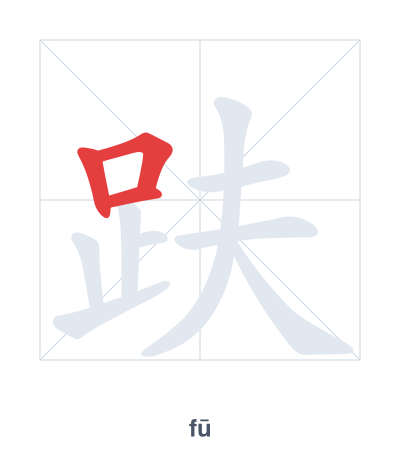
Open Hanzi Writer to see the animated stroke order and practice writing 趺 with real-time feedback.
The character 趺 (fū) is written with 11 strokes. Follow the standard Chinese stroke order: top to bottom, left to right, outside before inside. The radical 足 is one of its key components.
Practice the correct stroke order with the Hanzi Writer app to see animated stroke-by-stroke guidance with real-time feedback.
趺 means instep; to sit cross-legged.
The character 趺 combines the radical 足 (foot) with 夫 (man), which serves as a phonetic component. The foot radical conveys the meaning related to the foot (instep), while 夫 also evokes the image of a man sitting cross-legged—a posture called 趺坐 in meditation.
💡 Memory Tip: Picture a man (夫) resting his bottom on his own foot (足) to sit cross-legged, showing both the instep and the pose.
他在床上静静趺坐。
tā zài chuáng shàng jìng jìng fū zuò
He is sitting cross-legged quietly on the bed.
僧人正在跏趺而坐。
sēng rén zhèng zài jiā fū ér zuò
The monk is sitting in the lotus position.
他趺足坐在草地上。
tā fū zú zuò zài cǎo dì shàng
He sat cross-legged on the grass.
Open Hanzi Writer to see the animated stroke order and practice writing 趺 with real-time feedback.
✨ Animated stroke order · Handwriting recognition · HSK-graded practice · Free to use
趺 is made of the radical 足 (foot) on the left and the character 夫 (fū) on the right. The left part gives the meaning related to the foot, so 趺 means 'instep' or actions involving the foot. The right part 夫 provides the pronunciation fū.