滋 (zī) means "nourish; grow; taste" in Chinese. It has 12 strokes with the radical 氵, and is HSK Level 7.
Rated 4.2/5 in difficulty (advanced).
Harder than 68% of HSK Level 7 characters.
Appears in 3+ common words including 滋味 (zī wèi), 滋润 (zī rùn), 滋生 (zī shēng).
Due to its 12 strokes, Hanzi Writer's error detection shows 滋 requires focused practice — most learners need 10+ attempts for consistent accuracy.
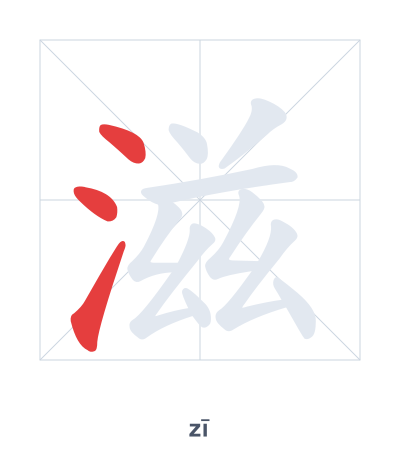
Open Hanzi Writer to see the animated stroke order and practice writing 滋 with real-time feedback.
The character 滋 (zī) is written with 12 strokes. Follow the standard Chinese stroke order: top to bottom, left to right, outside before inside. The radical 氵 is one of its key components.
Practice the correct stroke order with the Hanzi Writer app to see animated stroke-by-stroke guidance with real-time feedback.
滋 means nourish; grow; taste.
As an HSK Level 7 character, 滋 is an intermediate-level character.
滋 combines the water radical 氵 with 兹 (zī), which originally depicted sprouting grass over a thread (玄), suggesting growth. Water nourishes plants, so together they convey the idea of 'nourish' and 'grow'.
💡 Memory Tip: Imagine a plant (兹) drinking water (氵) to grow lush and tasty.
这道菜的滋味很好。
zhè dào cài de zī wèi hěn hǎo
The flavor of this dish is very good.
这种面霜非常滋润。
zhè zhǒng miàn shuāng fēi cháng zī rùn
This face cream is very moisturizing.
潮湿容易滋生细菌。
cháo shī róng yì zī shēng xì jūn
Dampness easily breeds bacteria.
Open Hanzi Writer to see the animated stroke order and practice writing 滋 with real-time feedback.
✨ Animated stroke order · Handwriting recognition · HSK-graded practice · Free to use
滋 consists of the water radical 氵 on the left and 兹 on the right. Water (氵) combined with grass and silk (兹) suggests the idea of moisture and nourishment, which connects to the meanings 'nourish', 'grow', and 'taste'.