壁 (bì) means "wall" in Chinese. It has 16 strokes with the radical 土, and is HSK Level 5.
Rated 4.2/5 in difficulty (advanced).
Harder than 62% of HSK Level 5 characters.
Appears in 3+ common words including 墙壁 (qiáng bì), 壁画 (bì huà), 隔壁 (gé bì).
Due to its 16 strokes, Hanzi Writer's error detection shows 壁 requires focused practice — most learners need 10+ attempts for consistent accuracy.
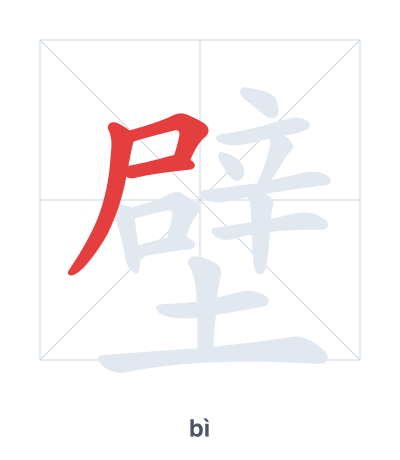
Open Hanzi Writer to see the animated stroke order and practice writing 壁 with real-time feedback.
The character 壁 (bì) is written with 16 strokes. Follow the standard Chinese stroke order: top to bottom, left to right, outside before inside. The radical 土 is one of its key components.
Practice the correct stroke order with the Hanzi Writer app to see animated stroke-by-stroke guidance with real-time feedback.
壁 means wall.
As an HSK Level 5 character, 壁 is an intermediate-level character.
壁 (bì) combines the phonetic component 辟 (pì, meaning 'to open' or 'side') with the radical 土 (earth), as traditional walls in China were often made of rammed earth. The character visually represents a 'side made of earth,' i.e., a wall.
💡 Memory Tip: Picture a wall (土) that is so 'piercing' (辟 sounds like 'pierce') that it blocks everything from passing through.
墙壁是白色的。
qiáng bì shì bái sè de
The wall is white.
这里的壁画很漂亮。
zhè lǐ de bì huà hěn piào liàng
The murals here are very beautiful.
他就住在我的隔壁。
tā jiù zhù zài wǒ de gé bì
He lives right next door to me.
Open Hanzi Writer to see the animated stroke order and practice writing 壁 with real-time feedback.
✨ Animated stroke order · Handwriting recognition · HSK-graded practice · Free to use
壁 is a compound character with the radical 土 (earth) at the bottom, indicating the material used to build walls. The top part 辟 provides the pronunciation bì. Together, they suggest a structure made of earth, which is the basic idea of a wall.