塾 (shú) means "private school (old style)" in Chinese. It has 14 strokes with the radical 土.
Rated 4.2/5 in difficulty (advanced).
Appears in 3+ common words including 私塾 (sī shú), 塾师 (shú shī), 家塾 (jiā shú).
Due to its 14 strokes, Hanzi Writer's error detection shows 塾 requires focused practice — most learners need 10+ attempts for consistent accuracy.
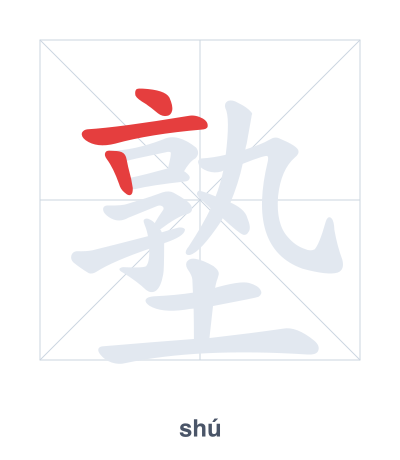
Open Hanzi Writer to see the animated stroke order and practice writing 塾 with real-time feedback.
The character 塾 (shú) is written with 14 strokes. Follow the standard Chinese stroke order: top to bottom, left to right, outside before inside. The radical 土 is one of its key components.
Practice the correct stroke order with the Hanzi Writer app to see animated stroke-by-stroke guidance with real-time feedback.
塾 means private school (old style).
The character 塾 combines 孰 (shú, meaning 'who' or 'ripe') above 土 (earth). It evokes a private school as a humble, earth-floored place where students' knowledge matures, like fruit ripening on the ground.
💡 Memory Tip: Picture a private school with a dirt floor (土) where the teacher keeps asking 'Who (孰) knows the answer?' as students sit on the ground.
以前有私塾。
yǐ qián yǒu sī shú
There used to be private schools.
塾师在教课。
shú shī zài jiào kè
The private school teacher is teaching.
他在家塾读书。
tā zài jiā shú dú shū
He is studying in a private family school.
Open Hanzi Writer to see the animated stroke order and practice writing 塾 with real-time feedback.
✨ Animated stroke order · Handwriting recognition · HSK-graded practice · Free to use
塾 combines the radical 土 (earth/ground) on top and 孰 (shú, meaning 'who' or 'ripe') below. The 土 radical suggests a physical place like a school building, while 孰 provides the pronunciation and hints at learning or maturity. Together, they create the idea of a place where students study and grow.