圣 (shèng) means "Holy; sacred; saint" in Chinese. It has 5 strokes with the radical 土, and is HSK Level 6.
Rated 2.9/5 in difficulty (moderate).
Harder than 7% of HSK Level 6 characters.
Appears in 3+ common words including 圣诞节 (shèng dàn jié), 圣地 (shèng dì), 圣人 (shèng rén).
Hanzi Writer's stroke validation shows learners typically need 5-8 attempts to write 圣 with correct proportion and order.
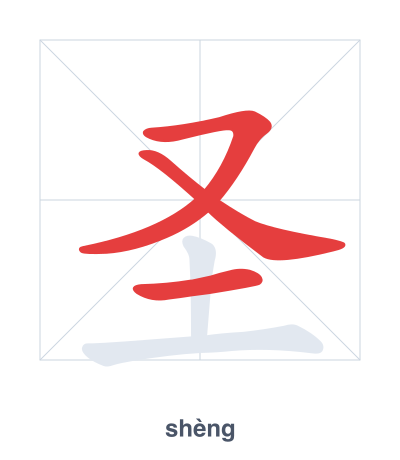
Open Hanzi Writer to see the animated stroke order and practice writing 圣 with real-time feedback.
The character 圣 (shèng) is written with 5 strokes. Follow the standard Chinese stroke order: top to bottom, left to right, outside before inside. The radical 土 is one of its key components.
Practice the correct stroke order with the Hanzi Writer app to see animated stroke-by-stroke guidance with real-time feedback.
圣 means Holy; sacred; saint.
As an HSK Level 6 character, 圣 is an intermediate-level character.
Originally, 圣 (聖) depicted a person with a large ear and mouth, symbolizing a sage who hears wisdom and speaks truth. The simplified form 圣 combines 又 (hand) and 土 (earth), suggesting a holy figure connected to the earth.
💡 Memory Tip: Imagine a holy saint (圣) standing on earth (土) with a hand (又) raised in blessing.
圣诞节快到了。
shèng dàn jié kuài dào le
Christmas is coming soon.
这里是旅游圣地。
zhè lǐ shì lǚ yóu shèng dì
This is a popular tourist destination.
孔子是古代圣人。
kǒng zi shì gǔ dài shèng rén
Confucius is an ancient sage.
Open Hanzi Writer to see the animated stroke order and practice writing 圣 with real-time feedback.
✨ Animated stroke order · Handwriting recognition · HSK-graded practice · Free to use
圣 consists of the component 又 (again/hand) on top of the radical 土 (earth). This simplified form does not directly reflect the original meaning of "holy" because it was changed from the traditional character 聖. In modern Chinese, the structure is just a visual symbol for the sound and meaning.