圯 (yí) means "Bridge (archaic)" in Chinese. It has 6 strokes with the radical 土.
Rated 3.2/5 in difficulty (challenging).
Appears in 3+ common words including 圯上 (yí shàng), 圯桥 (yí qiáo), 圯下 (yí xià).
Due to its 6 strokes, Hanzi Writer's error detection shows 圯 requires focused practice — most learners need 10+ attempts for consistent accuracy.
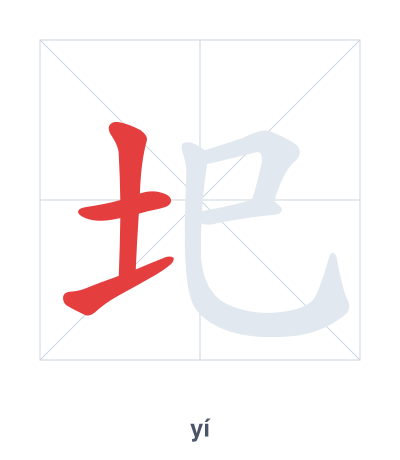
Open Hanzi Writer to see the animated stroke order and practice writing 圯 with real-time feedback.
The character 圯 (yí) is written with 6 strokes. Follow the standard Chinese stroke order: top to bottom, left to right, outside before inside. The radical 土 is one of its key components.
Practice the correct stroke order with the Hanzi Writer app to see animated stroke-by-stroke guidance with real-time feedback.
圯 means Bridge (archaic).
圯 is composed of the radical 土 (earth) and the phonetic component 巳 (sì/snake). It refers to an ancient earthen bridge; the character combines earth with a phonetic element that may also allude to the sinuous shape of a bridge.
💡 Memory Tip: Imagine an earthen bridge (土) with a snake (巳) slithering across it.
他在圯上遇到老人。
tā zài yí shàng yù dào lǎo rén
He met an old man on the bridge.
这是一个古老的圯桥。
zhè shì yí gè gǔ lǎo de yí qiáo
This is an ancient bridge.
鞋子掉到了圯下。
xié zi diào dào le yí xià
The shoe fell under the bridge.
Open Hanzi Writer to see the animated stroke order and practice writing 圯 with real-time feedback.
✨ Animated stroke order · Handwriting recognition · HSK-graded practice · Free to use
圯 is made of the radical 土 (earth) on the left and the component 巳 (a snake or self) on the right. The earth radical suggests a structure built from soil or stone, like an old bridge. The combination creates the archaic meaning of a bridge, though the exact reason for 巳 is not certain.