塲 (cháng) means "field; place" in Chinese. It has 14 strokes with the radical 土.
Rated 4.2/5 in difficulty (advanced).
Appears in 3+ common words including 塲地 (cháng dì), 塲合 (cháng hé), 运动塲 (yùn dòng cháng).
Due to its 14 strokes, Hanzi Writer's error detection shows 塲 requires focused practice — most learners need 10+ attempts for consistent accuracy.
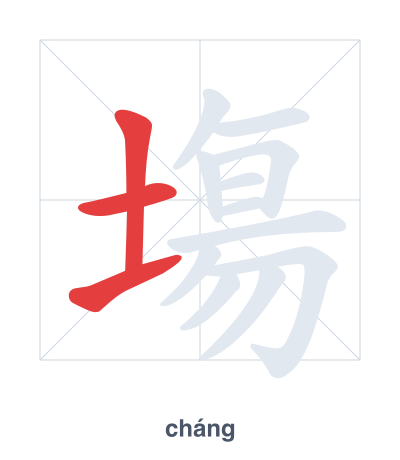
Open Hanzi Writer to see the animated stroke order and practice writing 塲 with real-time feedback.
The character 塲 (cháng) is written with 14 strokes. Follow the standard Chinese stroke order: top to bottom, left to right, outside before inside. The radical 土 is one of its key components.
Practice the correct stroke order with the Hanzi Writer app to see animated stroke-by-stroke guidance with real-time feedback.
塲 means field; place.
The character 塲 combines the radical 土 (earth) with 昜 (sunlight), depicting an open area of land bathed in sunlight—a field or place. It is a variant of the more common 場, where 昜 also suggests openness and expanse.
💡 Memory Tip: Picture the sun (昜) shining down on a plot of earth (土) turning it into a bright, open field (塲).
塲地非常大。
cháng dì fēi cháng dà
The venue is very large.
注意说话的塲合。
zhù yì shuō huà de cháng hé
Pay attention to the occasion when speaking.
我们去运动塲吧。
wǒ men qù yùn dòng cháng ba
Let's go to the sports field.
Open Hanzi Writer to see the animated stroke order and practice writing 塲 with real-time feedback.
✨ Animated stroke order · Handwriting recognition · HSK-graded practice · Free to use
塲 is made of the radical 土 (earth) on the left, which suggests the character relates to land or ground. The right part is 昜 (yáng), which originally meant 'sun rising' and gives a sense of open space. Together, 土+昜 forms a character for an open field or place on the earth.