墙 (qiáng) means "wall" in Chinese. It has 14 strokes with the radical 土, and is HSK Level 2.
Rated 3.7/5 in difficulty (challenging).
Harder than 72% of HSK Level 2 characters.
Appears in 3+ common words including 墙上 (qiáng shàng), 城墙 (chéng qiáng), 围墙 (wéi qiáng).
Due to its 14 strokes, Hanzi Writer's error detection shows 墙 requires focused practice — most learners need 10+ attempts for consistent accuracy.
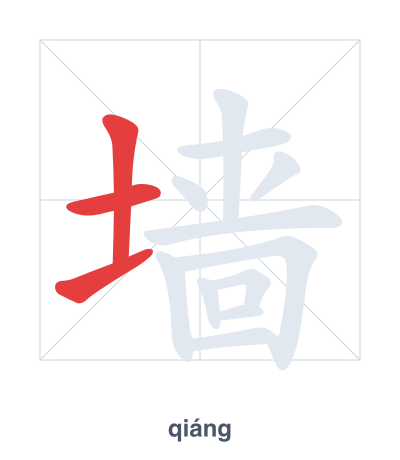
Open Hanzi Writer to see the animated stroke order and practice writing 墙 with real-time feedback.
The character 墙 (qiáng) is written with 14 strokes. Follow the standard Chinese stroke order: top to bottom, left to right, outside before inside. The radical 土 is one of its key components.
Practice the correct stroke order with the Hanzi Writer app to see animated stroke-by-stroke guidance with real-time feedback.
墙 means wall.
As an HSK Level 2 character, 墙 is among the first characters beginners learn.
墙 is a compound character combining the radical 土 (earth, soil) and 啬 (sè, originally depicting a granary or storehouse). In ancient China, walls were often made of rammed earth, and the component 啬 hints at the protective enclosure of a wall around a granary. The character thus visually represents an earth-built wall serving as a barrier.
💡 Memory Tip: Picture a wall made of packed earth (土) surrounding a granary (啬), guarding the precious grain inside.
墙上有一张画。
qiáng shàng yǒu yī zhāng huà
There is a picture on the wall.
西安有古老的城墙。
xī ān yǒu gǔ lǎo de chéng qiáng
Xi'an has ancient city walls.
学校的围墙很高。
xué xiào de wéi qiáng hěn gāo
The school's perimeter wall is very high.
Open Hanzi Writer to see the animated stroke order and practice writing 墙 with real-time feedback.
✨ Animated stroke order · Handwriting recognition · HSK-graded practice · Free to use
墙 is made of two parts: the radical 土 (earth) on the left and 啬 on the right. The radical 土 hints that a wall was traditionally built from earth or mud. The right part 啬 mainly provides the sound for the character.