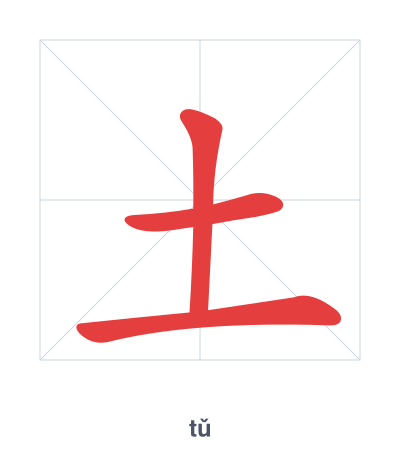
土 (tǔ) means "Soil; earth; dirt" in Chinese. It has 3 strokes with the radical 土, and is HSK Level 3.
Rated 2.2/5 in difficulty (moderate).
Harder than 2% of HSK Level 3 characters.
Appears in 3+ common words including 土地 (tǔ dì), 土豆 (tǔ dòu), 泥土 (ní tǔ).
Hanzi Writer's stroke validation shows learners typically need 5-8 attempts to write 土 with correct proportion and order.
Open Hanzi Writer to see the animated stroke order and practice writing 土 with real-time feedback.
The character 土 (tǔ) is written with 3 strokes. Follow the standard Chinese stroke order: top to bottom, left to right, outside before inside. The radical 土 is one of its key components.
Practice the correct stroke order with the Hanzi Writer app to see animated stroke-by-stroke guidance with real-time feedback.
土 means Soil; earth; dirt.
As an HSK Level 3 character, 土 is an intermediate-level character.
The character 土 originally depicted a lump of earth or a mound, as seen in ancient oracle bone script where it looked like a small pile of dirt. Over time, it simplified into three strokes: a horizontal line symbolizing the ground, a vertical line representing something thrust into it, and a base line for stability.
💡 Memory Tip: Imagine a cross (+) standing firmly on the ground, marking the spot where you dig up rich, dark soil.
这片土地很肥沃。
zhè piàn tǔ dì hěn féi wò
This land is very fertile.
我喜欢吃土豆。
wǒ xǐ huān chī tǔ dòu
I like eating potatoes.
泥土里有种子。
ní tǔ lǐ yǒu zhǒng zi
There are seeds in the soil.
Open Hanzi Writer to see the animated stroke order and practice writing 土 with real-time feedback.
✨ Animated stroke order · Handwriting recognition · HSK-graded practice · Free to use
土 is a simple pictograph that looks like a mound of earth. It consists of a horizontal top line, a vertical line through the middle, and a longer horizontal bottom line, representing soil piled up. There are no separate components; the entire character directly depicts its meaning of soil or earth.