在 (zài) means "At; in; on; to be present" in Chinese. It has 6 strokes with the radical 土, and is HSK Level 1.
Rated 2.7/5 in difficulty (moderate).
Harder than 41% of HSK Level 1 characters.
Appears in 3+ common words including 在家 (zài jiā), 正在 (zhèng zài), 在哪儿 (zài nǎ ér).
Hanzi Writer's stroke validation shows learners typically need 5-8 attempts to write 在 with correct proportion and order.
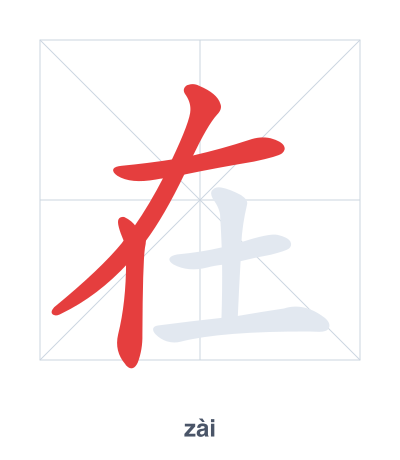
Open Hanzi Writer to see the animated stroke order and practice writing 在 with real-time feedback.
The character 在 (zài) is written with 6 strokes. Follow the standard Chinese stroke order: top to bottom, left to right, outside before inside. The radical 土 is one of its key components.
Practice the correct stroke order with the Hanzi Writer app to see animated stroke-by-stroke guidance with real-time feedback.
在 means At; in; on; to be present.
As an HSK Level 1 character, 在 is among the first characters beginners learn.
In ancient script, 在 depicted a plant (才) growing from the ground (土), symbolizing existence or presence at a location. The character combines the radical 土 (earth) with the phonetic component 才 to convey being 'at' or 'in' a place.
💡 Memory Tip: Imagine a sprout (才) rooted in the soil (土) — it is present right there, 'at' that spot.
我现在在家。
wǒ xiàn zài zài jiā
I am at home now.
他正在吃饭。
tā zhèng zài chī fàn
He is eating a meal.
你的书在哪儿?
nǐ de shū zài nǎ ér
Where is your book?
Open Hanzi Writer to see the animated stroke order and practice writing 在 with real-time feedback.
✨ Animated stroke order · Handwriting recognition · HSK-graded practice · Free to use
在 consists of the radical 土 (earth) on the bottom and a top part that resembles 才 (talent). The radical 土 suggests location or ground, which connects to the meaning 'at' or 'in' a place.