圪 (gē) means "A dialect prefix (often used in Northern China)" in Chinese. It has 6 strokes with the radical 土.
Rated 3.2/5 in difficulty (challenging).
Appears in 3+ common words including 圪塔 (gē tǎ), 圪节 (gē jié), 圪台 (gē tái).
Due to its 6 strokes, Hanzi Writer's error detection shows 圪 requires focused practice — most learners need 10+ attempts for consistent accuracy.
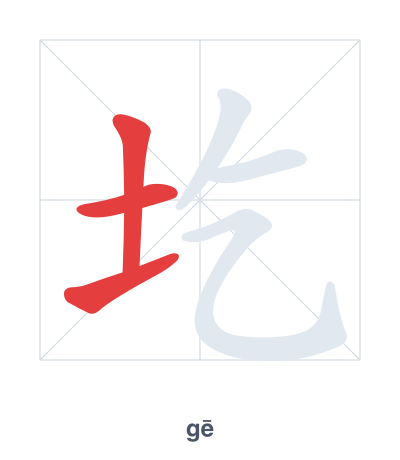
Open Hanzi Writer to see the animated stroke order and practice writing 圪 with real-time feedback.
The character 圪 (gē) is written with 6 strokes. Follow the standard Chinese stroke order: top to bottom, left to right, outside before inside. The radical 土 is one of its key components.
Practice the correct stroke order with the Hanzi Writer app to see animated stroke-by-stroke guidance with real-time feedback.
圪 means A dialect prefix (often used in Northern China).
圪 is a phono-semantic compound combining the radical 土 (earth) with 乞 (qǐ, 'beg') as a phonetic component. It originally appeared in northern Chinese dialects for words describing lumps of soil or uneven ground, like 圪垃 (gēla, clod).
💡 Memory Tip: Picture a small mound of earth (土) shaped like a beggar (乞) kneeling with outstretched arms, asking for a bit more dirt.
树上长了一个圪塔。
shù shàng zhǎng le yí gè gē tǎ
A knob has grown on the tree.
竹子有很多圪节。
zhú zi yǒu hěn duō gē jié
Bamboo has many nodes.
门前有一个小圪台。
mén qián yǒu yí gè xiǎo gē tái
There is a small platform in front of the door.
Open Hanzi Writer to see the animated stroke order and practice writing 圪 with real-time feedback.
✨ Animated stroke order · Handwriting recognition · HSK-graded practice · Free to use
The character 圪 is composed of the radical 土 (earth or ground) on the left and the phonetic component 乞 (gē) on the right. The 土 radical suggests something related to earth or terrain, while 乞 provides the sound. This structure fits the character's use as a prefix in northern dialect words describing small earthen features like lumps or mounds.