恋 (liàn) means "To love; to feel attached to" in Chinese. It has 10 strokes with the radical 心, and is HSK Level 5.
Rated 4.2/5 in difficulty (advanced).
Harder than 65% of HSK Level 5 characters.
Appears in 3+ common words including 恋爱 (liàn ài), 留恋 (liú liàn), 失恋 (shī liàn).
Due to its 10 strokes, Hanzi Writer's error detection shows 恋 requires focused practice — most learners need 10+ attempts for consistent accuracy.
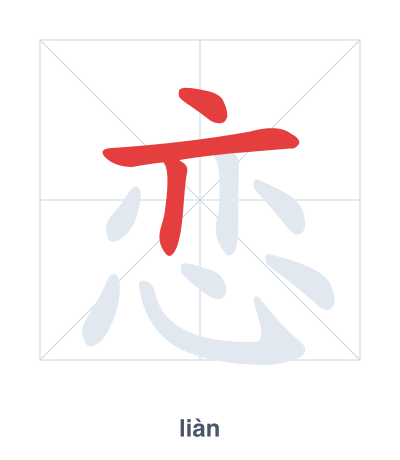
Open Hanzi Writer to see the animated stroke order and practice writing 恋 with real-time feedback.
The character 恋 (liàn) is written with 10 strokes. Follow the standard Chinese stroke order: top to bottom, left to right, outside before inside. The radical 心 is one of its key components.
Practice the correct stroke order with the Hanzi Writer app to see animated stroke-by-stroke guidance with real-time feedback.
恋 means To love; to feel attached to.
As an HSK Level 5 character, 恋 is an intermediate-level character.
恋 combines the phonetic component 亦 (yì, meaning 'also') with the radical 心 (xīn, meaning 'heart'), suggesting that love is a heartfelt emotion that also occupies the mind.
💡 Memory Tip: Picture the top part 亦 as a person with open arms embracing a heart (心) below, showing that love holds the heart closely.
他们正在谈恋爱。
tā men zhèng zài tán liàn ài
They are dating.
我很留恋这个地方。
wǒ hěn liú liàn zhè ge dì fāng
I'm very attached to this place.
他最近失恋了。
tā zuì jìn shī liàn le
He recently went through a breakup.
Open Hanzi Writer to see the animated stroke order and practice writing 恋 with real-time feedback.
✨ Animated stroke order · Handwriting recognition · HSK-graded practice · Free to use
恋 is made of two parts: the top is 亦 (yì, meaning "also") and the bottom is 心 (xīn, meaning "heart"). Since the heart radical often relates to emotions, the character suggests that love is a feeling that also comes from the heart.