Hanzi Writer

How to Write 忘 (wàng) — Meaning “To forget”

wàng HSK Level 1 7 strokes Radical: 心

忘 (wàng) means "To forget" in Chinese. It has 7 strokes with the radical 心, and is HSK Level 1.

Rated 2.9/5 in difficulty (moderate).

Harder than 55% of HSK Level 1 characters.

Appears in 3+ common words including 忘记 (wàng jì), 忘掉 (wàng diào), 难忘 (nán wàng).

Hanzi Writer's stroke validation shows learners typically need 5-8 attempts to write 忘 with correct proportion and order.
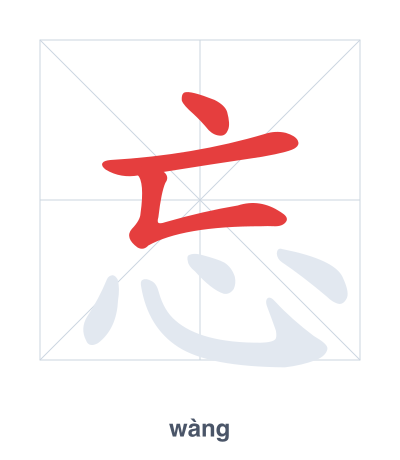
Stroke order practice for 忘 - wàng

Practice Writing 忘 (wàng)

Open Hanzi Writer to see the animated stroke order and practice writing 忘 with real-time feedback.

The character (wàng) is written with 7 strokes. Follow the standard Chinese stroke order: top to bottom, left to right, outside before inside. The radical is one of its key components.

Practice the correct stroke order with the Hanzi Writer app to see animated stroke-by-stroke guidance with real-time feedback.

means To forget.

As an HSK Level 1 character, is among the first characters beginners learn.

Character
Pinyinwàng (wang)
MeaningTo forget
Strokes7
Radical
HSK Level1
Difficulty2.9/5

忘 combines the radical 心 (heart/mind) with 亡 (to disappear or perish). The idea is that something vanishes or 'dies' from the mind, so you forget it.

💡 Memory Tip: Imagine a heart (心) that has a skull (亡) inside it—the memory has died and is forgotten.

wàng jì
To forget
wàng diào
To forget / to drop
nán wàng
unforgettable; memorable

我忘记带钥匙了。

wǒ wàng jì dài yào shi le

I forgot to bring my keys.

别忘掉这件事。

bié wàng diào zhè jiàn shì

Don't forget about this matter.

这是一个难忘的日子。

zhè shì yí gè nán wàng de rì zi

This is an unforgettable day.

Character Pinyin Strokes Radical
(current) wàng 7
5
7
rěn 7
Stroke order practice for 忘 - wàng

Practice Writing 忘 (wàng)

Open Hanzi Writer to see the animated stroke order and practice writing 忘 with real-time feedback.

✨ Animated stroke order · Handwriting recognition · HSK-graded practice · Free to use

Frequently Asked Questions about 忘

忘 is made of two parts: the top is 亡 (wáng, meaning 'to die' or 'lose') and the bottom is 心 (xīn, meaning 'heart'). Together, they suggest that something is lost from your heart or mind, which means you forget it.

More HSK Level 1 Characters

Characters with Radical 心

Other 7-Stroke Characters