忑 (tè) means "Unsettled (part of 'nervous')" in Chinese. It has 7 strokes with the radical 心.
Rated 3.5/5 in difficulty (challenging).
Appears in 3+ common words including 忐忑 (tǎn tè), 忐忑不安 (tǎn tè bù ān), 忑忑 (tè tè).
Due to its 7 strokes, Hanzi Writer's error detection shows 忑 requires focused practice — most learners need 10+ attempts for consistent accuracy.
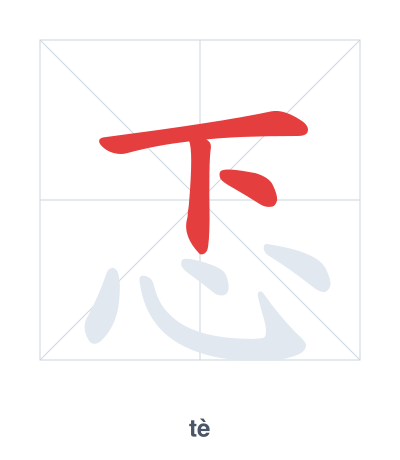
Open Hanzi Writer to see the animated stroke order and practice writing 忑 with real-time feedback.
The character 忑 (tè) is written with 7 strokes. Follow the standard Chinese stroke order: top to bottom, left to right, outside before inside. The radical 心 is one of its key components.
Practice the correct stroke order with the Hanzi Writer app to see animated stroke-by-stroke guidance with real-time feedback.
忑 means Unsettled (part of 'nervous').
This character is a compound of 上 (shàng, 'up/above') above 心 (xīn, 'heart'). The image is of a heart that is 'up' or in a high position, implying a restless, unsettled feeling—like a heart that jumps up with anxiety.
💡 Memory Tip: Picture a heart (心) with a little upward arrow (上) on top, symbolizing your heart racing up into your throat when you feel nervous.
别这么忐忑。
bié zhè me tǎn tè
Don't be so nervous.
考试前他忐忑不安。
kǎo shì qián tā tǎn tè bù ān
He was nervous before the exam.
他心里忑忑的。
tā xīn lǐ tè tè de
He feels nervous and uneasy.
Open Hanzi Writer to see the animated stroke order and practice writing 忑 with real-time feedback.
✨ Animated stroke order · Handwriting recognition · HSK-graded practice · Free to use
The character 忑 is made of two parts: the top is 上 (meaning 'up' or 'above') and the bottom is 心 (meaning 'heart'). Together, they suggest a heart that feels like it is jumping up, which conveys the meaning of being unsettled or nervous.