忐 (tǎn) means "Unsettled (part of 'nervous')" in Chinese. It has 7 strokes with the radical 心.
Rated 3.5/5 in difficulty (challenging).
Appears in 3+ common words including 忐忑 (tǎn tè), 忐忑不安 (tǎn tè bù ān), 心中忐忑 (xīn zhōng tǎn tè).
Due to its 7 strokes, Hanzi Writer's error detection shows 忐 requires focused practice — most learners need 10+ attempts for consistent accuracy.
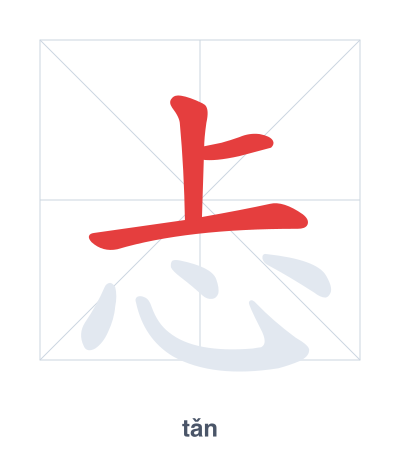
Open Hanzi Writer to see the animated stroke order and practice writing 忐 with real-time feedback.
The character 忐 (tǎn) is written with 7 strokes. Follow the standard Chinese stroke order: top to bottom, left to right, outside before inside. The radical 心 is one of its key components.
Practice the correct stroke order with the Hanzi Writer app to see animated stroke-by-stroke guidance with real-time feedback.
忐 means Unsettled (part of 'nervous').
忐 is a compound character combining 上 (above/up) and 心 (heart). The image is of the heart rising up into the throat, a physical sensation associated with nervousness or unease. This structure visually conveys the meaning of feeling unsettled or anxious.
💡 Memory Tip: Imagine your heart (心) leaping up (上) into your throat, making you feel totally unsettled.
他心里很忐忑。
tā xīn lǐ hěn tǎn tè
He felt very uneasy.
我感到忐忑不安。
wǒ gǎn dào tǎn tè bù ān
I feel nervous and uneasy.
他心中忐忑地等待。
tā xīn zhōng tǎn tè dì děng dài
He waited with an uneasy heart.
Open Hanzi Writer to see the animated stroke order and practice writing 忐 with real-time feedback.
✨ Animated stroke order · Handwriting recognition · HSK-graded practice · Free to use
忐 is composed of 上 (shàng, meaning 'up' or 'above') on top and 心 (xīn, meaning 'heart') on the bottom. This structure suggests a heart that is 'up' or unsettled, which relates to the feeling of unease. It always appears as part of the compound 忐忑 (tǎn tè), where both halves share a similar structure.