忌 (jì) means "to avoid; to be jealous of; taboo" in Chinese. It has 7 strokes with the radical 心, and is HSK Level 7.
Rated 3.5/5 in difficulty (challenging).
Harder than 17% of HSK Level 7 characters.
Appears in 3+ common words including 忌口 (jì kǒu), 忌妒 (jì dù), 禁忌 (jìn jì).
Due to its 7 strokes, Hanzi Writer's error detection shows 忌 requires focused practice — most learners need 10+ attempts for consistent accuracy.
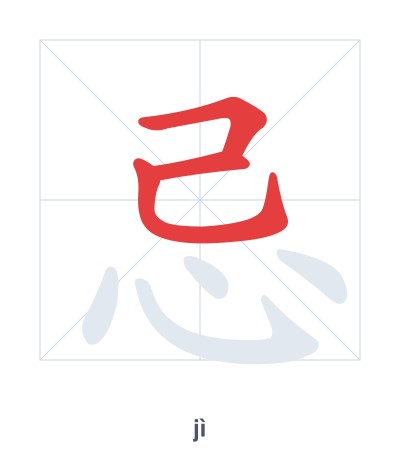
Open Hanzi Writer to see the animated stroke order and practice writing 忌 with real-time feedback.
The character 忌 (jì) is written with 7 strokes. Follow the standard Chinese stroke order: top to bottom, left to right, outside before inside. The radical 心 is one of its key components.
Practice the correct stroke order with the Hanzi Writer app to see animated stroke-by-stroke guidance with real-time feedback.
忌 means to avoid; to be jealous of; taboo.
As an HSK Level 7 character, 忌 is an intermediate-level character.
忌 combines 己 (self) and 心 (heart), suggesting a heart turned inward toward oneself, which can lead to jealousy or the desire to avoid certain things. The radical 心 (heart) indicates emotions, while 己 (self) hints at personal aversion or taboo.
💡 Memory Tip: Picture a heart (心) being coiled by a snake (己) — you'd be jealous of the snake's freedom and avoid it at all costs.
生病要忌口。
shēng bìng yào jì kǒu
One must avoid certain foods when sick.
不要忌妒别人。
bú yào jì dù bié rén
Don't be jealous of others.
这是当地的禁忌。
zhè shì dāng dì de jìn jì
This is a local taboo.
Open Hanzi Writer to see the animated stroke order and practice writing 忌 with real-time feedback.
✨ Animated stroke order · Handwriting recognition · HSK-graded practice · Free to use
忌 is composed of the radical 心 (heart/mind) on the bottom and 己 (self) on top. The heart radical indicates emotions like jealousy or avoidance, while 己 suggests the self — together the character expresses feelings or rules that come from within, such as avoiding something or being jealous.