忒 (tè) means "Too / excessively" in Chinese. It has 7 strokes with the radical 心.
Rated 3.5/5 in difficulty (challenging).
Appears in 3+ common words including 忒大 (tè dà), 忒好 (tè hǎo), 忒多 (tè duō).
Due to its 7 strokes, Hanzi Writer's error detection shows 忒 requires focused practice — most learners need 10+ attempts for consistent accuracy.
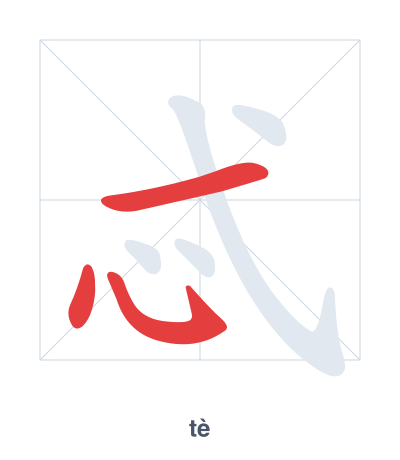
Open Hanzi Writer to see the animated stroke order and practice writing 忒 with real-time feedback.
The character 忒 (tè) is written with 7 strokes. Follow the standard Chinese stroke order: top to bottom, left to right, outside before inside. The radical 心 is one of its key components.
Practice the correct stroke order with the Hanzi Writer app to see animated stroke-by-stroke guidance with real-time feedback.
忒 means Too / excessively.
忒 is a compound character formed with 弋 (dart/arrow) as a phonetic component and 心 (heart) as the semantic component, suggesting an excessive emotional state that feels like being struck by a dart. This structure conveys the idea of 'too much' or 'excessively' as a feeling that pierces the heart.
💡 Memory Tip: Picture a heart (心) pierced by a dart (弋) — that hurts way too much!
这个苹果忒大了。
zhè ge píng guǒ tè dà le
This apple is way too big.
他的主意忒好了。
tā de zhǔ yì tè hǎo le
His idea is extremely good.
这里的作业忒多了。
zhè lǐ de zuò yè tè duō le
There is way too much homework here.
Open Hanzi Writer to see the animated stroke order and practice writing 忒 with real-time feedback.
✨ Animated stroke order · Handwriting recognition · HSK-graded practice · Free to use
忒 combines the radical 心 (heart, on the bottom) with 弋 (yì, a dagger-like shape) on top. The 弋 part suggests a sense of deviation or going beyond, and together with the heart radical, it conveys an emotional excess, like going too far in feeling or action.