伤 (shāng) means "Injury; wound; to hurt." in Chinese. It has 6 strokes with the radical 亻, and is HSK Level 3.
Rated 2.9/5 in difficulty (moderate).
Harder than 18% of HSK Level 3 characters.
Appears in 3+ common words including 受伤 (shòu shāng), 伤心 (shāng xīn), 伤害 (shāng hài).
Hanzi Writer's stroke validation shows learners typically need 5-8 attempts to write 伤 with correct proportion and order.
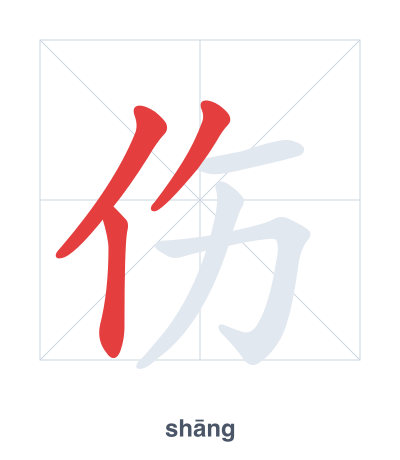
Open Hanzi Writer to see the animated stroke order and practice writing 伤 with real-time feedback.
The character 伤 (shāng) is written with 6 strokes. Follow the standard Chinese stroke order: top to bottom, left to right, outside before inside. The radical 亻 is one of its key components.
Practice the correct stroke order with the Hanzi Writer app to see animated stroke-by-stroke guidance with real-time feedback.
伤 means Injury; wound; to hurt..
As an HSK Level 3 character, 伤 is an intermediate-level character.
The character 伤 (shāng) combines the radical 亻 (person) with a right component that resembles a knife or a cut, suggesting a person who has been wounded. In its traditional form 傷, it originally depicted a person struck by an arrow, linking the visual to injury and pain.
💡 Memory Tip: Picture a person (亻) with a deep gash on their arm, shaped like the bent knife (the right part 勹) that caused the wound.
他的腿受伤了。
tā de tuǐ shòu shāng le
His leg is injured.
别为这件事伤心。
bié wèi zhè jiàn shì shāng xīn
Don't be sad about this.
不要伤害小动物。
bú yào shāng hài xiǎo dòng wù
Don't hurt small animals.
Open Hanzi Writer to see the animated stroke order and practice writing 伤 with real-time feedback.
✨ Animated stroke order · Handwriting recognition · HSK-graded practice · Free to use
The left side is the radical 亻, which represents a person. The right side is 力, meaning strength or force. Together, they suggest a person being hit by force, which leads to injury or harm.