忍 (rěn) means "to endure; to tolerate" in Chinese. It has 7 strokes with the radical 心, and is HSK Level 5.
Rated 3.5/5 in difficulty (challenging).
Harder than 23% of HSK Level 5 characters.
Appears in 3+ common words including 忍不住 (rěn bú zhù), 忍受 (rěn shòu), 容忍 (róng rěn).
Due to its 7 strokes, Hanzi Writer's error detection shows 忍 requires focused practice — most learners need 10+ attempts for consistent accuracy.
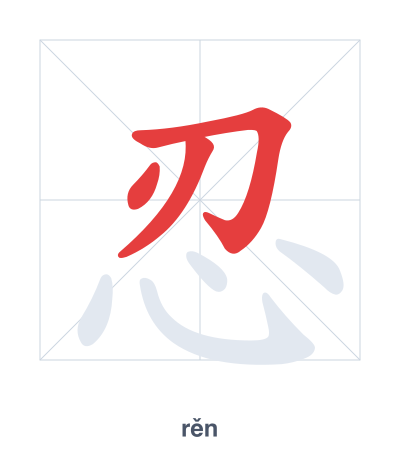
Open Hanzi Writer to see the animated stroke order and practice writing 忍 with real-time feedback.
The character 忍 (rěn) is written with 7 strokes. Follow the standard Chinese stroke order: top to bottom, left to right, outside before inside. The radical 心 is one of its key components.
Practice the correct stroke order with the Hanzi Writer app to see animated stroke-by-stroke guidance with real-time feedback.
忍 means to endure; to tolerate.
As an HSK Level 5 character, 忍 is an intermediate-level character.
忍 combines 刃 (rèn, 'blade') above 心 (xīn, 'heart'), literally 'a blade on the heart'—a vivid metaphor for enduring pain or suppressing emotions. The ancient form already showed a knife over a heart, symbolizing the inner strength needed to tolerate suffering without breaking.
💡 Memory Tip: Imagine a blade (刃) pressing into your heart (心) while you grit your teeth and silently endure the pain.
我忍不住笑了。
wǒ rěn bú zhù xiào le
I couldn't help laughing.
他无法忍受吵闹。
tā wú fǎ rěn shòu chǎo nào
He cannot stand the noise.
老师对他很容忍。
lǎo shī duì tā hěn róng rěn
The teacher is very tolerant of him.
Open Hanzi Writer to see the animated stroke order and practice writing 忍 with real-time feedback.
✨ Animated stroke order · Handwriting recognition · HSK-graded practice · Free to use
忍 has two parts: the top is 刃 (rèn, meaning 'blade') and the bottom is 心 (xīn, meaning 'heart'). The blade above the heart suggests enduring pain or pressure, which connects to the meaning of 'to endure' or 'to tolerate'.