糟 (zāo) means "Messy / Bad / Distiller's grains" in Chinese. It has 17 strokes with the radical 米, and is HSK Level 5.
Rated 4.2/5 in difficulty (advanced).
Harder than 87% of HSK Level 5 characters.
Appears in 3+ common words including 糟糕 (zāo gāo), 糟透了 (zāo tòu le), 乱糟糟 (luàn zāo zāo).
Due to its 17 strokes, Hanzi Writer's error detection shows 糟 requires focused practice — most learners need 10+ attempts for consistent accuracy.
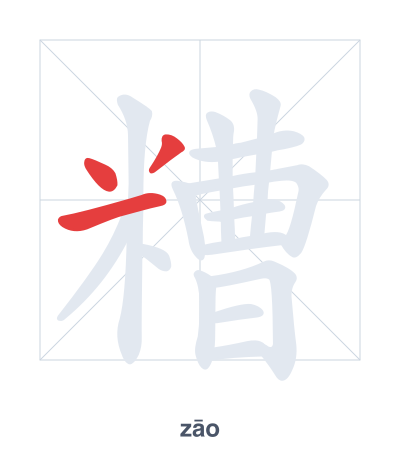
Open Hanzi Writer to see the animated stroke order and practice writing 糟 with real-time feedback.
The character 糟 (zāo) is written with 17 strokes. Follow the standard Chinese stroke order: top to bottom, left to right, outside before inside. The radical 米 is one of its key components.
Practice the correct stroke order with the Hanzi Writer app to see animated stroke-by-stroke guidance with real-time feedback.
糟 means Messy / Bad / Distiller's grains.
As an HSK Level 5 character, 糟 is an intermediate-level character.
糟 is a phono-semantic compound. The left part 米 (rice/grain) indicates the meaning relates to grain products, specifically distiller's grains (fermented leftovers from brewing). The right part 曹 (cáo) provides the phonetic clue for the sound zāo and also evokes the idea of a container or process where grains spoil. Over time, the meaning extended from 'distiller's grains' to 'messy' or 'bad' because such leftovers are disordered and undesirable.
💡 Memory Tip: Imagine rice (米) piled in a brewing vat (曹) turning into soggy, smelly distiller's grains — that's when things get really messy and bad!
事情变得很糟糕。
shì qíng biàn dé hěn zāo gāo
Things have become very bad.
今天的运气糟透了。
jīn tiān de yùn qì zāo tòu le
Today's luck is terrible.
房间里乱糟糟的。
fáng jiān lǐ luàn zāo zāo de
The room is a mess.
Open Hanzi Writer to see the animated stroke order and practice writing 糟 with real-time feedback.
✨ Animated stroke order · Handwriting recognition · HSK-graded practice · Free to use
The character 糟 consists of the radical 米 (rice) on the left and 曹 on the right. The rice radical suggests the original meaning of distiller's grains, which are leftover from brewing rice. Over time, the character came to mean "messy" or "bad" because fermented grains can look and smell unpleasant.