糅 (róu) means "To mix" in Chinese. It has 15 strokes with the radical 米.
Rated 4.2/5 in difficulty (advanced).
Appears in 3+ common words including 糅合 (róu hé), 杂糅 (zá róu), 糅杂 (róu zá).
Due to its 15 strokes, Hanzi Writer's error detection shows 糅 requires focused practice — most learners need 10+ attempts for consistent accuracy.
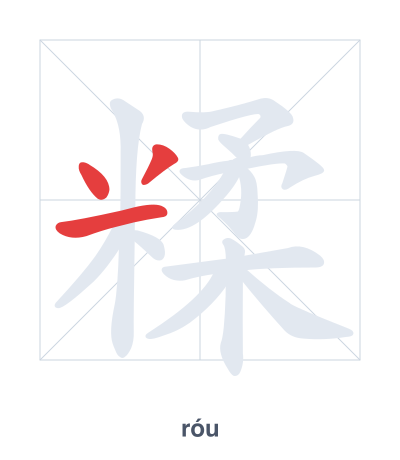
Open Hanzi Writer to see the animated stroke order and practice writing 糅 with real-time feedback.
The character 糅 (róu) is written with 15 strokes. Follow the standard Chinese stroke order: top to bottom, left to right, outside before inside. The radical 米 is one of its key components.
Practice the correct stroke order with the Hanzi Writer app to see animated stroke-by-stroke guidance with real-time feedback.
糅 means To mix.
糅 combines the radical 米 (rice, grain) with 柔 (soft, flexible), which also provides the sound. The idea is that by mixing ingredients—like rice with water or other grains—you create a soft, blended mass, so the character visually represents blending until smooth.
💡 Memory Tip: Picture a cook stirring a bowl of rice (米) with a soft (柔) wooden spoon, mixing it all together into a sticky dough.
这种风格糅合了中西。
zhè zhǒng fēng gé róu hé le zhōng xī
This style blends Chinese and Western elements.
他的文章词句杂糅。
tā de wén zhāng cí jù zá róu
His writing has a mix of styles and confused wording.
各种声音糅杂在一起。
gè zhǒng shēng yīn róu zá zài yì qǐ
Various sounds are mixed together.
Open Hanzi Writer to see the animated stroke order and practice writing 糅 with real-time feedback.
✨ Animated stroke order · Handwriting recognition · HSK-graded practice · Free to use
糅 is made of 米 (rice, grain) on the left and 柔 (róu, meaning soft) on the right. The 米 component suggests food or grain, while 柔 provides a pronunciation hint and also implies mixing soft materials together. Together, they form the idea of blending or mixing things, like mixing rice with other ingredients.