糇 (hóu) means "Dry food" in Chinese. It has 15 strokes with the radical 米.
Rated 4.2/5 in difficulty (advanced).
Appears in 3+ common words including 糇粮 (hóu liáng), 糇食 (hóu shí), 糇粑 (hóu bā).
Due to its 15 strokes, Hanzi Writer's error detection shows 糇 requires focused practice — most learners need 10+ attempts for consistent accuracy.
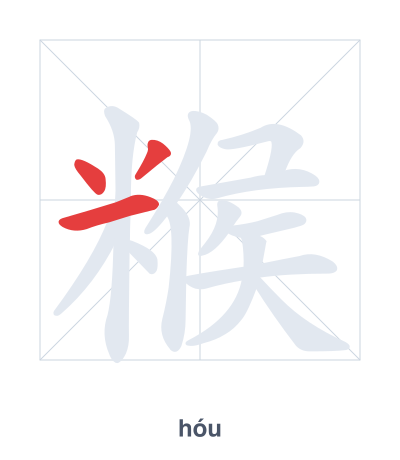
Open Hanzi Writer to see the animated stroke order and practice writing 糇 with real-time feedback.
The character 糇 (hóu) is written with 15 strokes. Follow the standard Chinese stroke order: top to bottom, left to right, outside before inside. The radical 米 is one of its key components.
Practice the correct stroke order with the Hanzi Writer app to see animated stroke-by-stroke guidance with real-time feedback.
糇 means Dry food.
糇 is a phono-semantic compound combining the radical 米 (rice/grain) with 侯 (hóu, 'marquis') as a phonetic component. The radical indicates it relates to food, specifically dry or preserved grains like travel provisions.
💡 Memory Tip: Picture a marquis (侯) on a long march, forced to eat nothing but dry rice (米) from a pouch—that's his 糇.
战士们带着糇粮。
zhàn shì men dài zhe hóu liáng
The soldiers carried dry rations.
准备一些糇食。
zhǔn bèi yī xiē hóu shí
Prepare some dry provisions.
他在吃糇粑。
tā zài chī hóu bā
He is eating roasted flour cake.
Open Hanzi Writer to see the animated stroke order and practice writing 糇 with real-time feedback.
✨ Animated stroke order · Handwriting recognition · HSK-graded practice · Free to use
糇 is composed of the radical 米 (rice) on the left and the phonetic component 侯 on the right. The rice radical suggests the character relates to food, specifically dry or stored grains. The right part gives the pronunciation hóu, making this a semantic-phonetic compound.