透 (tòu) means "To penetrate / Transparent" in Chinese. It has 10 strokes with the radical 辶, and is HSK Level 4.
Rated 4.2/5 in difficulty (advanced).
Harder than 94% of HSK Level 4 characters.
Appears in 3+ common words including 透明 (tòu míng), 透气 (tòu qì), 透支 (tòu zhī).
Due to its 10 strokes, Hanzi Writer's error detection shows 透 requires focused practice — most learners need 10+ attempts for consistent accuracy.
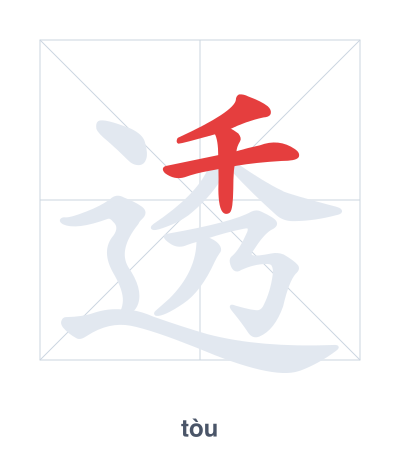
Open Hanzi Writer to see the animated stroke order and practice writing 透 with real-time feedback.
The character 透 (tòu) is written with 10 strokes. Follow the standard Chinese stroke order: top to bottom, left to right, outside before inside. The radical 辶 is one of its key components.
Practice the correct stroke order with the Hanzi Writer app to see animated stroke-by-stroke guidance with real-time feedback.
透 means To penetrate / Transparent.
As an HSK Level 4 character, 透 is an intermediate-level character.
透 is a compound character: the radical 辶 (walk/action) suggests movement through something, while the phonetic component 秀 (xiù) originally depicted a grain plant with ears of wheat, implying something slender that can pass through. Together, they convey the idea of penetrating or passing through to the other side, hence 'to penetrate' and 'transparent' (allowing light to pass through).
💡 Memory Tip: Picture a person (辶) walking right through a field of elegant grain stalks (秀) — they pass through completely, becoming transparent.
玻璃是透明的。
bō lí shì tòu míng de
Glass is transparent.
这件衣服很透气。
zhè jiàn yī fú hěn tòu qì
This piece of clothing is very breathable.
他的信用卡透支了。
tā de xìn yòng kǎ tòu zhī le
His credit card is overdrawn.
Open Hanzi Writer to see the animated stroke order and practice writing 透 with real-time feedback.
✨ Animated stroke order · Handwriting recognition · HSK-graded practice · Free to use
透 consists of the radical 辶 (walking) on the left and 秀 on the right. The radical suggests movement or passing through, which connects to the meaning "to penetrate." The right part provides phonetic guidance and does not directly contribute to the meaning.