阅 (yuè) means "To read; to review; to experience" in Chinese. It has 10 strokes with the radical 门, and is HSK Level 4.
Rated 4.2/5 in difficulty (advanced).
Harder than 99% of HSK Level 4 characters.
Appears in 3+ common words including 阅读 (yuè dú), 阅览室 (yuè lǎn shì), 查阅 (chá yuè).
Due to its 10 strokes, Hanzi Writer's error detection shows 阅 requires focused practice — most learners need 10+ attempts for consistent accuracy.
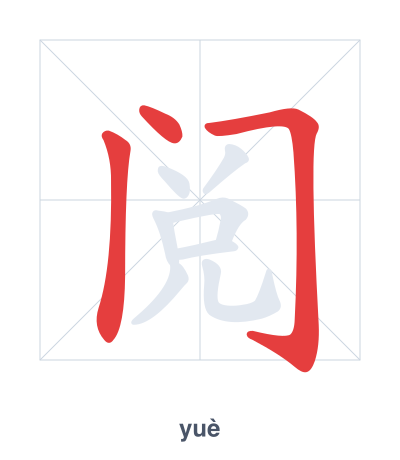
Open Hanzi Writer to see the animated stroke order and practice writing 阅 with real-time feedback.
The character 阅 (yuè) is written with 10 strokes. Follow the standard Chinese stroke order: top to bottom, left to right, outside before inside. The radical 门 is one of its key components.
Practice the correct stroke order with the Hanzi Writer app to see animated stroke-by-stroke guidance with real-time feedback.
阅 means To read; to review; to experience.
As an HSK Level 4 character, 阅 is an intermediate-level character.
The character 阅 combines the radical 门 (gate) with 兑 (exchange, also phonetic). Originally it depicted the act of reviewing or inspecting troops passing through a gate, later extending to mean reading, reviewing, or experiencing something firsthand.
💡 Memory Tip: Picture a gate (门) where people exchange (兑) books to read and review each other's stories.
我每天坚持阅读。
wǒ měi tiān jiān chí yuè dú
I keep up with reading every day.
阅览室里很安静。
yuè lǎn shì lǐ hěn ān jìng
It is very quiet in the reading room.
请查阅这本字典。
qǐng chá yuè zhè běn zì diǎn
Please consult this dictionary.
Open Hanzi Writer to see the animated stroke order and practice writing 阅 with real-time feedback.
✨ Animated stroke order · Handwriting recognition · HSK-graded practice · Free to use
The character 阅 is composed of the radical 门 (door, gate) on the outside and 兑 inside. 门 suggests an entrance or passage, while 兑 provides the sound and hints at exchange or examination. Together, they convey the idea of passing through a door to examine or read something.