Hanzi Writer

How to Write 俳 (pái) — Meaning “actor or vaudeville”

pái 10 strokes Radical: 亻

俳 (pái) means "actor or vaudeville" in Chinese. It has 10 strokes with the radical 亻.

Rated 3.9/5 in difficulty (challenging).

Appears in 3+ common words including 俳句 (pái jù), 俳优 (pái yōu), 俳谐 (pái xié).

Due to its 10 strokes, Hanzi Writer's error detection shows 俳 requires focused practice — most learners need 10+ attempts for consistent accuracy.
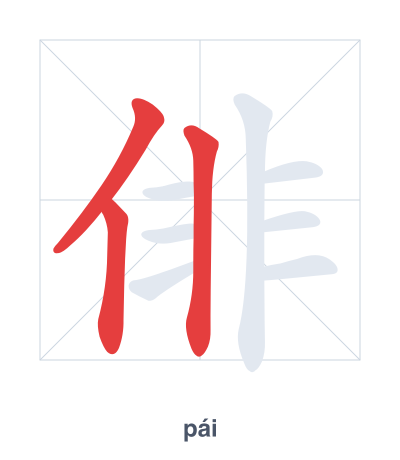
Stroke order practice for 俳 - pái

Practice Writing 俳 (pái)

Open Hanzi Writer to see the animated stroke order and practice writing 俳 with real-time feedback.

The character (pái) is written with 10 strokes. Follow the standard Chinese stroke order: top to bottom, left to right, outside before inside. The radical is one of its key components.

Practice the correct stroke order with the Hanzi Writer app to see animated stroke-by-stroke guidance with real-time feedback.

means actor or vaudeville.

Character
Pinyinpái (pai)
Meaningactor or vaudeville
Strokes10
Radical
Difficulty3.9/5

俳 is a compound character combining the radical 亻 (person) with the phonetic component 非 (fēi, meaning 'not' or 'wrong'). The idea is that an actor or vaudeville performer is a person who 'is not' their true self, instead playing a role or presenting a comedic facade.

💡 Memory Tip: Picture a person (亻) wearing a giant mask shaped like the word '非' (not), pretending to be someone else on stage.

pái jù
haiku
pái yōu
actor or entertainer
pái xié
humorous or playful

他喜欢写俳句。

tā xǐ huān xiě pái jù

He likes writing haiku.

俳优在台上表演。

pái yōu zài tái shàng biǎo yǎn

The actors are performing on stage.

他的话语十分俳谐。

tā de huà yǔ shí fēn pái xié

His words were very humorous.

Character Pinyin Strokes Radical
(current) pái 10
pèi 8
lǎo 8
yáng 8
Stroke order practice for 俳 - pái

Practice Writing 俳 (pái)

Open Hanzi Writer to see the animated stroke order and practice writing 俳 with real-time feedback.

✨ Animated stroke order · Handwriting recognition · HSK-graded practice · Free to use

Frequently Asked Questions about 俳

俳 is composed of the radical 亻 (person) on the left and 非 on the right. The radical 亻 indicates that the character relates to people, while 非 contributes to the pronunciation and also suggests a sense of being opposite or unconventional, fitting for actors who play different roles.

Characters with Radical 亻

Other 10-Stroke Characters