閦 (chù) means "crowd or name of a Buddha" in Chinese. It has 14 strokes with the radical 门.
Rated 4.2/5 in difficulty (advanced).
Appears in 3+ common words including 阿閦佛 (ā chù fú), 閦众 (chù zhòng), 閦伽 (chù gā).
Due to its 14 strokes, Hanzi Writer's error detection shows 閦 requires focused practice — most learners need 10+ attempts for consistent accuracy.
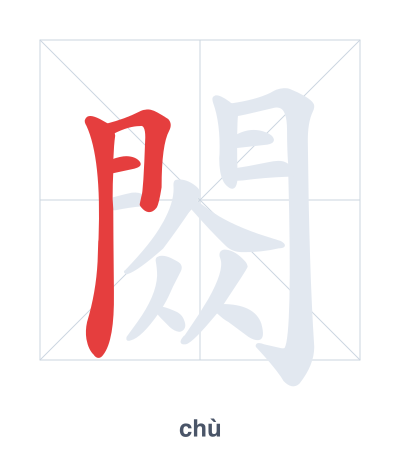
Open Hanzi Writer to see the animated stroke order and practice writing 閦 with real-time feedback.
The character 閦 (chù) is written with 14 strokes. Follow the standard Chinese stroke order: top to bottom, left to right, outside before inside. The radical 门 is one of its key components.
Practice the correct stroke order with the Hanzi Writer app to see animated stroke-by-stroke guidance with real-time feedback.
閦 means crowd or name of a Buddha.
閦 is a compound character combining the radical 门 (gate) with 众 (crowd of three people), suggesting a crowd gathered at a gate. Originally it depicted many people thronging inside or through a city gate, hence the meaning 'crowd'. It is also used as a transliteration in Buddhist names, like 閦婆 (Chùpó).
💡 Memory Tip: Picture a crowded gate (门) with three people (众) squeezing through at once—chaos and a crowd! (chù sounds like 'chute'—people shooting out like a crowd from a chute.)
他在拜阿閦佛。
tā zài bài ā chù fú
He is worshipping Akshobhya Buddha.
閦众是佛教词语。
chù zhòng shì fó jiào cí yǔ
'Chu zhong' is a Buddhist term.
閦伽是古代译名。
chù gā shì gǔ dài yì míng
'Chu jia' is an ancient transliterated name.
Open Hanzi Writer to see the animated stroke order and practice writing 閦 with real-time feedback.
✨ Animated stroke order · Handwriting recognition · HSK-graded practice · Free to use
閦 is made of the radical 门 (door) on the outside and the component 众 (crowd of people) inside. Together, they suggest many people gathered in a doorway or enclosed space, which connects to its meaning of "crowd." The character is also used to transliterate the name of a Buddha.