㼌 (yǔ) means "weak; feeble" in Chinese. It has 10 strokes with the radical 瓜.
Rated 4.2/5 in difficulty (advanced).
Appears in 3+ common words including 㼌㼌 (yǔ yǔ), 瓜㼌 (guā yǔ), 㼌儿 (yǔ ér).
Due to its 10 strokes, Hanzi Writer's error detection shows 㼌 requires focused practice — most learners need 10+ attempts for consistent accuracy.
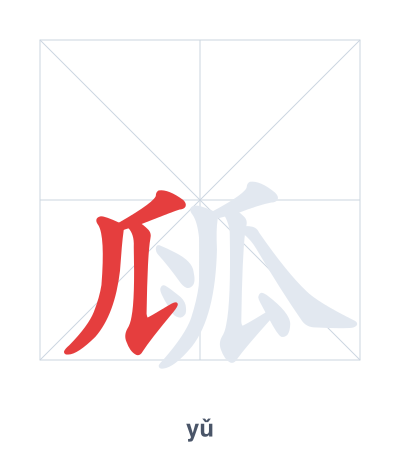
Open Hanzi Writer to see the animated stroke order and practice writing 㼌 with real-time feedback.
The character 㼌 (yǔ) is written with 10 strokes. Follow the standard Chinese stroke order: top to bottom, left to right, outside before inside. The radical 瓜 is one of its key components.
Practice the correct stroke order with the Hanzi Writer app to see animated stroke-by-stroke guidance with real-time feedback.
㼌 means weak; feeble.
| Character | 㼌 |
| Pinyin | yǔ (yu) |
| Meaning | weak; feeble |
| Strokes | 10 |
| Radical | 瓜 |
| Difficulty | 4.2/5 |
㼌 is a compound character with the radical 瓜 (melon/gourd) and the phonetic component 㐬 (liú), which originally depicted a baby or flowing liquid. The meaning 'weak, feeble' derives from the image of a melon that is soft, underdeveloped, or drooping—unable to hold its own form.
💡 Memory Tip: Picture a melon (瓜) that is so weak it's sagging and dripping like a limp, squishy blob (㐬).
这个东西看起来㼌㼌的。
zhè ge dōng xī kàn qǐ lái yǔ yǔ de 。
This thing looks weak and worn out.
地里有很多瓜㼌。
Dì lǐ yǒu hěn duō guā yǔ.
There are many melons and gourds in the field.
那是一个小㼌儿。
Nà shì yí gè xiǎo yǔ ér.
That is a small, weak creature.
Open Hanzi Writer to see the animated stroke order and practice writing 㼌 with real-time feedback.
✨ Animated stroke order · Handwriting recognition · HSK-graded practice · Free to use
The character 㼌 is made of the radical 瓜 (melon) on the left and the component 予 on the right. The radical suggests a connection to melons or plants, while 予 can imply giving or smallness, together forming the idea of something weak or feeble like a small, underdeveloped melon.