闩 (shuān) means "To bolt / A latch" in Chinese. It has 4 strokes with the radical 门.
Rated 2.7/5 in difficulty (moderate).
Appears in 3+ common words including 门闩 (mén shuān), 闩门 (shuān mén), 插闩 (chā shuān).
Hanzi Writer's stroke validation shows learners typically need 5-8 attempts to write 闩 with correct proportion and order.
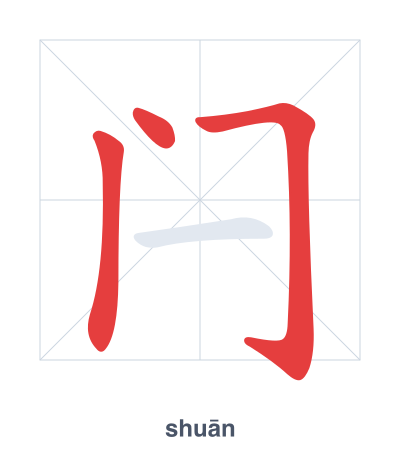
Open Hanzi Writer to see the animated stroke order and practice writing 闩 with real-time feedback.
The character 闩 (shuān) is written with 4 strokes. Follow the standard Chinese stroke order: top to bottom, left to right, outside before inside. The radical 门 is one of its key components.
Practice the correct stroke order with the Hanzi Writer app to see animated stroke-by-stroke guidance with real-time feedback.
闩 means To bolt / A latch.
This character combines the radical 门 (door) with a horizontal stroke 一, depicting a crossbar placed across a door to lock it. The one stroke represents the bolt itself, sliding into place to secure the entrance.
💡 Memory Tip: Imagine a door (门) with a single sturdy horizontal bar (一) sliding across to lock it tight.
这个门闩坏了。
zhè ge mén shuān huài le
This door bolt is broken.
睡觉前要闩门。
shuì jiào qián yào shuān mén
Bolt the door before going to sleep.
他把门插闩了。
tā bǎ mén chā shuān le
He bolted the door.
Open Hanzi Writer to see the animated stroke order and practice writing 闩 with real-time feedback.
✨ Animated stroke order · Handwriting recognition · HSK-graded practice · Free to use
闩 is made of the radical 门 (door) on the outside and a vertical bar inside. The bar represents the bolt that slides across to lock the door, so the structure directly illustrates 'a latch' or 'to bolt'.