闰 (rùn) means "leap (as in leap year) / extra" in Chinese. It has 7 strokes with the radical 门.
Rated 3.5/5 in difficulty (challenging).
Appears in 3+ common words including 闰年 (rùn nián), 闰月 (rùn yuè), 闰日 (rùn rì).
Due to its 7 strokes, Hanzi Writer's error detection shows 闰 requires focused practice — most learners need 10+ attempts for consistent accuracy.
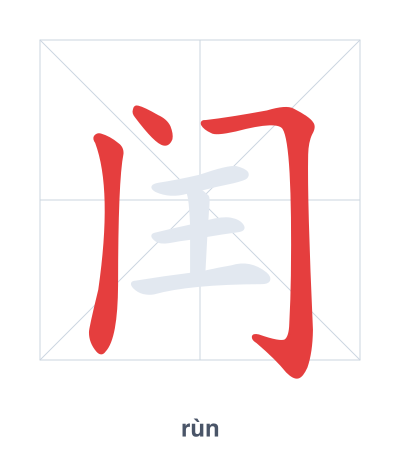
Open Hanzi Writer to see the animated stroke order and practice writing 闰 with real-time feedback.
The character 闰 (rùn) is written with 7 strokes. Follow the standard Chinese stroke order: top to bottom, left to right, outside before inside. The radical 门 is one of its key components.
Practice the correct stroke order with the Hanzi Writer app to see animated stroke-by-stroke guidance with real-time feedback.
闰 means leap (as in leap year) / extra.
The character 闰 originally depicted an intercalary month in the lunar calendar. It combines 门 (door) with 壬 (a person standing), symbolizing something extra 'entering' the normal sequence, like a leap month inserted into the year.
💡 Memory Tip: Picture a king (王) stepping through a door (门) to announce an extra day for the leap year.
今年是闰年。
jīn nián shì rùn nián
This year is a leap year.
农历有闰月。
nóng lì yǒu rùn yuè
The lunar calendar has leap months.
闰日是二月二十九。
rùn rì shì èr yuè èr shí jiǔ
Leap day is February 29th.
Open Hanzi Writer to see the animated stroke order and practice writing 闰 with real-time feedback.
✨ Animated stroke order · Handwriting recognition · HSK-graded practice · Free to use
闰 is made of the radical 门 (door/gate) on the outside, and 王 (king/jade) inside. The 门 suggests an extra entry or something that goes beyond the normal, while 王 can represent a ruler or important addition, together hinting at an extra or leap concept.