闹 (nào) means "Noisy; to make a scene; to disturb" in Chinese. It has 8 strokes with the radical 门, and is HSK Level 4.
Rated 3.7/5 in difficulty (challenging).
Harder than 51% of HSK Level 4 characters.
Appears in 3+ common words including 闹钟 (nào zhōng), 热闹 (rè nào), 别闹 (bié nào).
Due to its 8 strokes, Hanzi Writer's error detection shows 闹 requires focused practice — most learners need 10+ attempts for consistent accuracy.
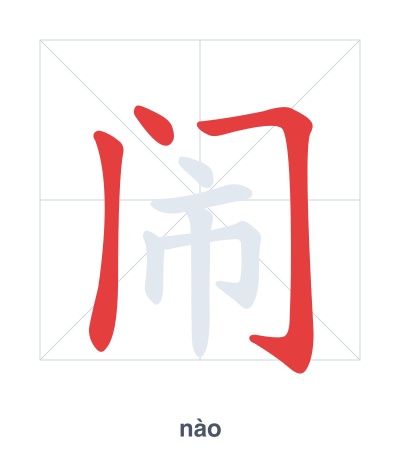
Open Hanzi Writer to see the animated stroke order and practice writing 闹 with real-time feedback.
The character 闹 (nào) is written with 8 strokes. Follow the standard Chinese stroke order: top to bottom, left to right, outside before inside. The radical 门 is one of its key components.
Practice the correct stroke order with the Hanzi Writer app to see animated stroke-by-stroke guidance with real-time feedback.
闹 means Noisy; to make a scene; to disturb.
As an HSK Level 4 character, 闹 is an intermediate-level character.
闹 is a compound character combining the radical 门 (door/gate) and 市 (market). The image is of a market inside a gate, which naturally implies noise and commotion. This visually conveys the meaning of being noisy or making a scene.
💡 Memory Tip: Picture a busy market (市) crammed inside a gate (门), where the loud haggling and chaos create a noisy disturbance.
闹钟响了。
nào zhōng xiǎng le
The alarm clock went off.
这里很热闹。
zhè lǐ hěn rè nào
It is very lively here.
别闹了,快学习。
bié nào le kuài xué xí
Stop messing around and go study.
Open Hanzi Writer to see the animated stroke order and practice writing 闹 with real-time feedback.
✨ Animated stroke order · Handwriting recognition · HSK-graded practice · Free to use
闹 is made of the radical 门 (door) on the outside and the phonetic component 市 (market) inside. Together, they suggest the idea of noise or disturbance coming from a market through a door. This structure directly relates to its meaning of being noisy or making a scene.