Hanzi Writer

How to Write 问 (wèn) — Meaning “to ask”

wèn HSK Level 1 6 strokes Radical: 门

问 (wèn) means "to ask" in Chinese. It has 6 strokes with the radical 门, and is HSK Level 1.

Rated 2.7/5 in difficulty (moderate).

Harder than 49% of HSK Level 1 characters.

Appears in 3+ common words including 问题 (wèn tí), 问好 (wèn hǎo), 请问 (qǐng wèn).

Hanzi Writer's stroke validation shows learners typically need 5-8 attempts to write 问 with correct proportion and order.
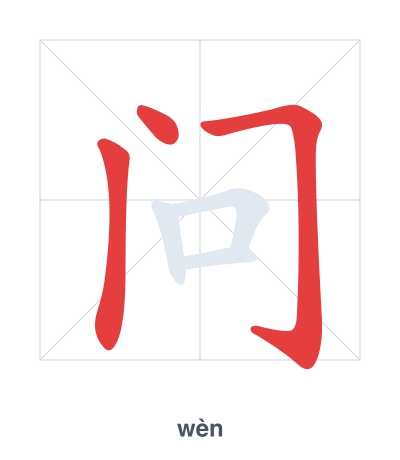
Stroke order practice for 问 - wèn

Practice Writing 问 (wèn)

Open Hanzi Writer to see the animated stroke order and practice writing 问 with real-time feedback.

The character (wèn) is written with 6 strokes. Follow the standard Chinese stroke order: top to bottom, left to right, outside before inside. The radical is one of its key components.

Practice the correct stroke order with the Hanzi Writer app to see animated stroke-by-stroke guidance with real-time feedback.

means to ask.

As an HSK Level 1 character, is among the first characters beginners learn.

Character
Pinyinwèn (wen)
Meaningto ask
Strokes6
Radical
HSK Level1
Difficulty2.7/5

问 combines 门 (door/gate) with 口 (mouth). The mouth at the gate represents someone opening their mouth to ask a question when arriving at a door.

💡 Memory Tip: Imagine a mouth (口) peeking through a door (门) to ask 'Who's there?'

wèn tí
question / problem / issue
wèn hǎo
to say hello / to send regards
qǐng wèn
Excuse me / May I ask?

我有一个问题。

wǒ yǒu yí gè wèn tí

I have a question.

向老师问好。

xiàng lǎo shī wèn hǎo

Say hello to the teacher.

请问厕所在哪?

qǐng wèn cè suǒ zài nǎ

Excuse me, where is the toilet?

Character Pinyin Strokes Radical
(current) wèn 6
shuān 4
shǎn 5
yán 6
Stroke order practice for 问 - wèn

Practice Writing 问 (wèn)

Open Hanzi Writer to see the animated stroke order and practice writing 问 with real-time feedback.

✨ Animated stroke order · Handwriting recognition · HSK-graded practice · Free to use

Frequently Asked Questions about 问

问 is composed of the radical 门 (door) on the outside and 口 (mouth) inside. The mouth inside the door suggests speaking through an opening, which represents the act of asking a question or seeking information.

More HSK Level 1 Characters

Characters with Radical 门

Other 6-Stroke Characters